Get Full Government Meeting Transcripts, Videos, & Alerts Forever!
Get email alerts on the Asbestos Abatement topic
No spam. Unsubscribe anytime.
Staff brief residents on asbestos, lead and PCB cleanup at decommissioned Earl & Wit School in Stafford Springs
Summary
Town staff and consultants described the EPA-funded abatement of asbestos, lead paint and PCB-containing materials in the vacant Earl & Wit School at 20 High Park Road, explained safety controls and monitoring, and outlined a phased schedule (interior in 2026, roof work in 2027) and disposal procedures.
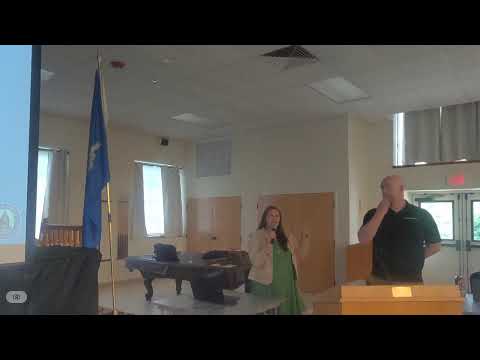
Amber (staff member) opened the June community briefing in Stafford Springs to outline the planned cleanup at the decommissioned Earl & Wit School at 20 High Park Road and to introduce the project team, including Sarah Dphano, project officer with Weston & Samson, and Craig Miner, the project’s hazardous building materials expert. She said the town received a cleanup grant in 2022 that is funding the current work and thanked the select board and state supporters for additional help.
Craig Miner described the contaminants the team will remove — asbestos, lead-based paint and certain PCB-containing materials — and explained why each requires special handling. "There are three main things we’re concerned with here: asbestos, lead, PCBs," he said, noting those materials can be present in pipe insulation, ceiling plaster, window caulking and ballasts. He described containment practices that will be used inside work areas: sealed negative-pressure enclosures, HEPA filtration units exhausting outdoors, workers in protective suits and respirators, and observation by an independent, licensed asbestos project monitor.
The team summarized regulatory oversight and testing. A site-specific quality assurance plan will be reviewed by the EPA; Connecticut agencies cited during the presentation included the Department of Public Health (DPH) and the Department of Energy and Environmental Protection (DEEP); federal OSHA work-practice rules govern contractor safety. Craig explained that interior clearances require final visual inspection and air sampling, and in larger abatement areas transmission electron microscopy (TEM) lab analysis will be used as required by state rules.
Staff reviewed procurement and schedule milestones. Bids were solicited in mid-May; seven bids were received in early June and a recommendation to award was submitted to the town on June 11. Staff said the town expects the contractor on site in early July and that EPA grant timing requires the project to be substantially complete in early September with final completion paperwork due by late September. Amber added the town recently secured a $1.3 million Community Investment Fund grant for roof abatement and replacement (phase two, currently targeted for 2027) and a $241,000 grant from the Capital Region Council of Governments to assist oversight.
Speakers walked through community-facing logistics: work hours will generally be Monday–Friday, 7 a.m.–3:30 p.m.; no road closures are anticipated; equipment and waste staging will be kept inside the defined limits of work and behind six-foot fencing during the project; windows that need removal will be boarded; and waste containers will be closed, labeled and kept inside the fenced area until shipment. Craig described how hazardous waste will be handled: double-bagged, sealed and placed in lined boxes and containers with waste shipment records so disposal can be traced to licensed asbestos waste facilities out of state.
During a substantial Q&A, residents asked whether intact asbestos-containing materials can be left in place, how the town will verify contractor progress, and what protections exist for nearby features such as a duck pond and the popular sledding hill. Craig said whether material may remain depends on condition and material type — intact, undisturbed asbestos-containing materials can sometimes remain under management, but the current design aims to remove most identified asbestos-containing materials inside the building. He added that Connecticut requires removal of PCB-containing materials above 1 part per million and that AHERA school monitoring rules apply for occupied schools. On oversight, the contractor must submit a detailed schedule, a licensed third-party asbestos monitor will be on site to verify work practices and sampling, and grant reimbursement will be conditioned on documentation (payroll, weight slips, disposal manifests and Davis-Bacon wage verifications).
On disposal and transport the team said asbestos waste is typically managed as special waste and shipped to licensed asbestos-only landfill cells in other states; drivers must have DOT training to transport the material but a hazmat endorsement is not required for this special waste classification. If a containment breach were to occur (for example, major equipment failure, fire or weather event), work would stop, the area would be sealed and the team would re-evaluate and carry out corrective actions; the presenters said they have not observed a sustained exterior release in Craig’s years of work.
The session closed with a commitment to keep the public informed: Amber said she will provide monthly updates at select board meetings and post documents and reports on the town’s brownfields page at stafford.org. Residents were offered handouts and contact information for follow-up questions.
Next steps: contract execution, contractor mobilization expected in early July, interior abatement in 2026 with targeted roof abatement and replacement in a separate, state-funded phase in 2027. The town emphasized multiple layers of monitoring, documentation and regulatory review during abatement.