Get Full Government Meeting Transcripts, Videos, & Alerts Forever!
Get email alerts on the Metering Policy topic
No spam. Unsubscribe anytime.
Commission tables policy to limit one town water meter per structure pending Planning & Zoning input
Summary
Richmond commissioners debated a draft policy limiting each structure to a single town water meter per water service line, discussed duplex/condominium exceptions and grandfathering, and agreed to invite Planning & Zoning for enforcement guidance before finalizing the policy.
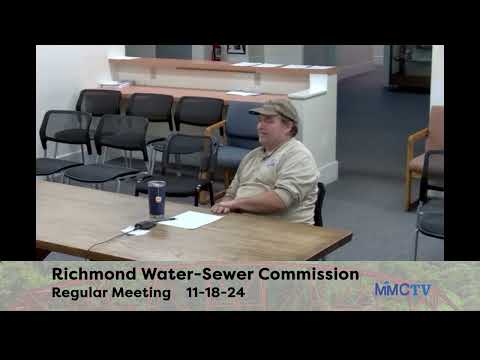
The Richmond Water and Sewer Commission continued discussion Nov. 18 of a draft policy that would limit each structure to one town water meter per water service line and require separate service lines where multiple meters are sought.
Staff read amended language that would allow multiple town meters only where a building has two or more owners who possess physically separate portions of the building and each portion has its own service line. The draft also contains a grandfathering clause: structures that currently have multiple meters would not be required to come into compliance when the policy is adopted, but new construction or future subdivisions could be required to meet the rule.
Commissioners raised several practical concerns: where a duplex is held in single ownership and later sold in parts, how condominiums and mixed commercial/residential buildings are treated, and how the commission would learn of ownership changes to enforce the rule. Members noted billing implications — fixed fees are currently charged per side/unit even when a single meter serves multiple units — and emphasized that enforcement likely requires coordination with Planning & Zoning and the town clerk, because meter and building permits are not handled by the Water & Sewer Commission alone.
Several commissioners suggested inviting Planning & Zoning to a future meeting to advise on enforceability and potential cross‑references in zoning and building permit processes. The commission agreed to table the policy for now and return to it after input from Planning & Zoning and town administrative offices.
Quotes in the discussion included commissioners emphasizing practicalities: one member noted, "if you're building a duplex... it's more of a legal situation" and others said the town should "put two lines in when you're already excavated" for new construction. The meeting record shows the commission has debated this draft over multiple sessions and will take another draft informed by Planning & Zoning feedback before voting.
Next steps: staff will invite Planning & Zoning to a future meeting and revise the policy language to clarify enforcement triggers and grandfathering language.