Get Full Government Meeting Transcripts, Videos, & Alerts Forever!
Get email alerts on the Career Training topic
No spam. Unsubscribe anytime.
Laramie County pilot links industry and high schools through new Trades Academy
Summary
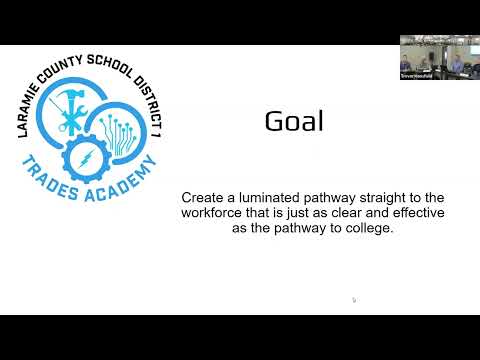
Laramie County School District 1 piloted a Trades Academy that brings industry partners into classrooms, offers second‑semester jobsite experiences and a learn‑to‑earn stipend model; district and business leaders said the program aims to give students an alternative path to traditional four‑year college.
Adam Kaiser, workforce partnership facilitator for Laramie County School District 1, told the Wyoming Workforce Development Council that the district’s new Trades Academy is meant to put local employers directly in front of students so they can "explain opportunities" and spark interest in skilled-trades careers. Kaiser said the pilot, which began at South High School and expanded to all four Cheyenne high schools, offers 45‑minute weekly industry sessions, job‑site internships for seniors and a second‑semester block allowing students to spend several hours daily on worksite training while still earning school credit.
"We can't have our students understand your opportunities until you're in front of them explaining them to us," Kaiser said, describing long-standing gaps between industry and schools. The academy partners range from skilled‑trades employers—Pinnacle Cabinets and local welders—to technology and construction firms such as BWXT, which the presenters said will bring modular‑nuclear demonstrations to students.
The program includes a "learn‑to‑earn" stipend in which students accrue small payments for attending pre‑apprenticeship courses and industry events; employers agree to contribute part of that stipend when a student signs an employment agreement and completes a probationary period. Kaiser said the model helps smaller local employers compete with larger firms by subsidizing early wages and giving students demonstrable work experience.
Larry Fodor, a longtime industry partner who helped create the Trades Academy, said the initiative grew from a NextGen sector partnership in 2019 and a bus tour that exposed school counselors and principals to local construction careers. Fodor and Kaiser credited trade associations, the Wyoming Business Alliance and industry sponsors for helping scale the effort and for securing private funding such as a Metallica Scholars grant that will fund a pre‑apprenticeship HVAC training lab.
Council members asked whether the model is scalable statewide. Kaiser and other speakers said the concept depends on industry willingness to participate and on local ecosystem supports—community colleges, employers, and intermediary organizations—but noted that eight school districts already have similar positions. Lauren Shenfeld and others said the Wyoming Business Alliance and Wyoming Innovation Partnership are working to adapt the model for other counties.
Kaiser and Fodor said the Trades Academy focuses on excitement and exposure as much as on curriculum, using hands‑on events such as AGC Trades Day and school‑based "data center day" to show students real equipment and job tasks. The presenters said the strategy appears to be increasing student interest in trade careers and in some cases engaging female students in traditionally male‑dominated fields.
The council acknowledged funding and staffing as remaining barriers and discussed options such as targeted certification pathways and employer contributions. The Trades Academy leaders encouraged employers and council members to volunteer time, host tours, or contribute to stipends and training scholarships.
The council did not take formal action; presenters said they will continue piloting program elements and exploring replication across districts.