Get Full Government Meeting Transcripts, Videos, & Alerts Forever!
Get email alerts on the Community Resilience Grant topic
No spam. Unsubscribe anytime.
Presenters outline Community Resilience Partnership grant; residents favor building weatherization and sidewalks
Summary
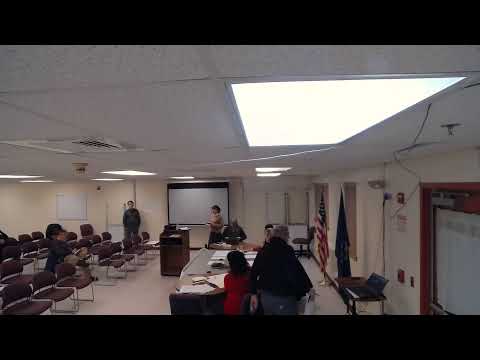
At a town workshop, nonprofit presenters described the Community Resilience Partnership grant (up to $75,000, or $175,000 for multi-town applications) and led residents through a self-evaluation. Attendees prioritized building weatherization, sidewalks and emergency planning as potential one-project applications; volunteers signed up to help write the application.
Dinos, a presenter with a nonprofit organization, opened a community workshop to review the Community Resilience Partnership grant and to validate a locally drafted self-evaluation form. He said the grant is administered by the governor's office (referred to in the transcript as the "main office of community affairs") and supports projects that reduce carbon emissions, advance clean energy and increase climate resilience.
Why it matters: The grant offers municipalities direct planning and implementation support for resilience projects; single-town awards can reach $75,000, while joint applications with other towns can request up to $175,000. Attendees said the town should pick one focused project this round and pursue additional projects in later years.
Presenters walked the group through program mechanics and the enrollment timeline, saying municipalities must complete two self-evaluation forms, hold a public workshop (this meeting), and adopt a municipal resolution (targeted for February) before applying. The tentative application window was described as March–May. The presenters emphasized that approximately 72 listed actions require no local match; proposals outside that list generally require a 10% local match.
Discussion highlights included several concrete project ideas mapped to the grant's action list. Frequently mentioned priorities were: performing building-envelope weatherization and installing energy-efficient equipment in public buildings (items referenced as B3/B4/B5), repairing and adding sidewalks and crosswalks near the school to improve child pedestrian safety, and planning improvements for drinking water, wastewater or stormwater systems.
Residents also discussed community amenities and site reuse: reviving a village-area farmers market on a privately owned brownfield parcel, addressing flooding in an older cemetery, and exploring better access to local farms. One participant noted an ongoing conversation with Western Maine Transportation about a possible bus route to increase ridership.
Public safety training for modern vehicle technology drew support as well. One attendee recommended A6 — NFPA-accredited training for first responders to safely handle fires involving electric vehicle batteries — and argued it would help the fire department respond to evolving risks from EVs.
Participants raised questions about whether funds from this program could be used as the town's local match for other grants. Presenters said state funds might be used as match in some cases but advised the town to verify the rules for any specific external grant; several attendees expressed uncertainty and asked staff to confirm allowable match sources.
On process and scope, presenters urged the group to focus on a single, well-defined project for this round rather than submitting a long list of unrelated activities. They said linked activities that clearly form one project (for example, insulation plus a coordinated HVAC upgrade) could be argued as a single application. Joint regional projects — such as a trail system connecting neighboring towns — were identified as attractive but likely better suited for a future, multi-town application.
Volunteers and next steps: Cory (whose last name was spelled aloud during the meeting) offered to help with application preparation. Presenters said they will meet with volunteers beginning in March once the application opens, and that the town would be responsible for collecting estimated costs and vendor quotes to include in the application.
There were no motions or formal votes during the workshop. The next procedural step stated in the meeting was adoption of a municipal resolution after the public workshop to complete enrollment in the partnership and make the town eligible to apply.
The presenters provided printed materials and encouraged participants to prioritize one project to pursue for this round; they said additional projects could be pursued in subsequent years.