Get Full Government Meeting Transcripts, Videos, & Alerts Forever!
Get email alerts on the Food Security topic
No spam. Unsubscribe anytime.
Little Rock launches 'Anyone Can, Anytime' 24/7 neighborhood pantries to expand food access
Summary
City leaders announced a year-round network of small, free 'Anyone Can, Anytime' pantries and a mobile food market funded in part with ARPA dollars; the initiative includes student-built pantry boxes and a call for 'pantry champions' to maintain sites across every ward.
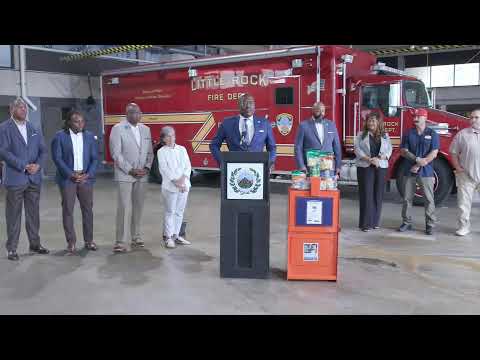
At a news event at Central Fire Station, the mayor of Little Rock announced the "Anyone Can, Anytime" small-food-pantry initiative and described partnerships with city departments, Little Rock Metro and the school district to expand year-round access to free food across the city.
The program, funded in part with American Rescue Plan Act dollars and coordinated by the Department of Community Programs, will place small, publicly accessible pantries at fire stations and community centers and ask neighborhood groups, churches and businesses to adopt them as "pantry champions." "This is our way of being helpful from the City of Little Rock perspective," the mayor said, describing the effort as part of a broader strategy that includes a mobile food market.
Michael Sanders, director of the Department of Community Programs, said the idea grew from conversations with Dr. Jackie Eves and firefighter Matthew Stallings and expands the department's annual Anyone Can food drive into year-round neighborhood support. "The answer became, anyone can anytime," Sanders said, urging volunteer groups to sign up at lrdcpcares.org to adopt a pantry for 30 days and help keep it stocked.
Sanders said the city will track donations placed in the pantries and the number of items taken to identify "hot-spot" areas and better target support. "Our hope is that these little food pantries help relieve some of that burden while also giving residents, city departments, churches, civic groups, businesses, and organizations another way to serve," he said.
Chad Moore, a teacher at the Little Rock Metro Career Technical Center, described a student-led fabrication project that repurposed decommissioned newspaper boxes into weatherproof pantry cabinets. "Our students were able to use their skills directly that serves the community and their own neighborhoods," Moore said, noting the work provided practical experience and a tangible community benefit.
Officials listed pantry sites across every ward, including Fire Station One at 624 Chester Street; Station 3 at 4321 West 22nd Street; the Wright Avenue Neighborhood Resource Center; the Southwest Community Center; Fire Station 7 at 4101 West Markham Street; Fire Station 9 at 1509 Green Mountain Drive; Fire Station 23 at 4500 Rawlings Road; West Central Community Center at 8616 Colonel Glenn Road; and Fire Station 11 at 5300 South University. Sanders said the pantries are intended for 24/7 access so residents can obtain food when they need it.
City leaders framed the initiative as a response to rising local need; Sanders referenced Feeding America reporting that about one in four children in Arkansas face hunger. The mayor emphasized that rising costs, including higher gasoline prices, can cut into household food budgets and said the city hopes the pantries and mobile market join broader community efforts to reduce that strain.
The city is asking community groups, neighborhood associations, faith institutions, nonprofits, businesses and families to sign up to maintain pantries for 30-day rotations via lrdcpcares.org. Officials said the program launch brings together public agencies, students and volunteers but provided no timetable for program evaluation beyond ongoing tracking of donations and withdrawals.