Get Full Government Meeting Transcripts, Videos, & Alerts Forever!
Get email alerts on the Alternative Energy topic
No spam. Unsubscribe anytime.
Residents press commissioners on solar/battery project risks, bonds, road use and plume analysis
Summary
At a lengthy public-comment period, residents raised fire‑safety, water availability, decommissioning-bond sufficiency, road damage, surveying/trespass, and transparency concerns about the Crossine/AES solar and lithium‑battery project and urged the county to tighten land‑use rules and oversight.
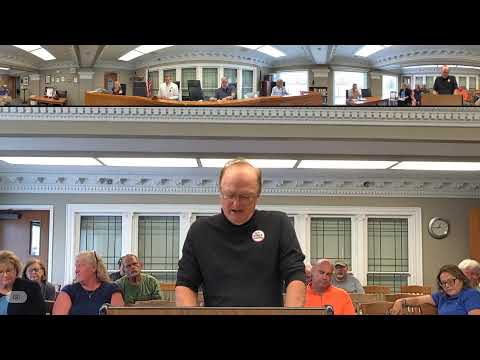
A multi‑hour public‑comment session at the Dubois County Commissioners meeting focused on safety, financial and transparency concerns tied to the Crossine (AES/EDP) solar and battery project and a proposed Phase II expansion.
Residents said they were troubled by what they described as inconsistent communications from developers, unclear acreage and lease counts for a proposed Phase II, and incidents they characterized as surveying on private property without permission. Multiple speakers raised the risk of lithium‑battery thermal‑runaway events, questioned whether the county’s road‑use bonds and decommissioning guarantees are sufficient, and asked whether there is adequate local water and firefighter capacity to respond to large battery fires. One resident summarized worries about potential contamination pathways should panels or batteries be damaged in storms or fire.
Barb Ho, a nearby resident and organizer of local commenters, told commissioners she had asked AES/EDP questions about phase sizes and bonding and said she was told inconsistent figures. She urged changes to the county’s ordinance to expand setback distances from homes and add landscape buffers, noting that state law limits a county’s ability to outright prohibit alternative energy projects but that local standards can be made more restrictive. “I’m asking you to look at the ordinance to be more restrictive so it protects the land owners that don’t want to do this,” she said.
Several speakers pressed for transparent public records and said county staff replies to records requests left open questions about whether the county performed independent technical reviews of developer materials. One public records requester, Jaci Lamb, said the county’s response indicated the county received numerous documents — road‑use agreements, a decommissioning plan, plume‑analysis materials — but that the county had not conducted independent engineering reviews and that certain files provided were incomplete or in formats that required technical tools to read.
Commissioners and staff responded that many technical elements — plume modeling, fire-mitigation design, specialized emergency-response planning and some bond calculations — are prepared by developer consultants and state or regional authorities; the county reviews permit materials, records the agreements and enforces road‑use agreements, but county staff said they do not always perform independent engineering simulations in-house. Commissioners said they cannot simply ban legally permitted projects but they can consider more restrictive local rules, explore moratoriums for short, specified intervals while policy is reviewed, and require stronger bonds or supplemental assurances. One commissioner noted a reassessment calculation the assessor's office uses — converting land from agricultural valuation to a commercial solar valuation (mentioned in the meeting as changing assessed value to roughly $7,700 per acre) — which affects tax outcomes.
Residents also asked for regular, accessible updates and for the county to track bond renewals, road‑use permit compliance and emergency‑response planning milestones. Commissioners agreed to take additional public input and to coordinate with staff and legal counsel on whether ordinance amendments, moratoria or other procedural changes are feasible and lawful. The county did not announce immediate regulatory changes during the meeting.