Get Full Government Meeting Transcripts, Videos, & Alerts Forever!
Get email alerts on the Winter Maintenance topic
No spam. Unsubscribe anytime.
Ann Arbor public works details heavy winter, first snow‑parking ban and plans to rebid sidewalk contract
Summary
City staff told the Transportation Committee that this winter cost roughly $1.3 million and required 43 maintenance events; staff credited new truck‑tracking technology for better verification, described limits in contractor capacity, and said the first snow‑parking ban modestly improved plow efficiency while prompting outreach and contract changes.
Paul Matthews, a city presenter, told the Ann Arbor Transportation Committee on June 17 that the public works department spent about $1.3 million responding to this winter’s storms and ran 43 distinct winter maintenance events.
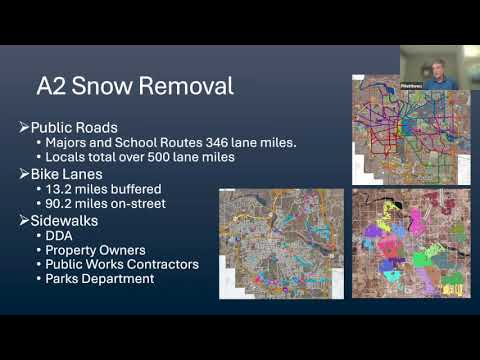
Matthews said the department’s winter maintenance goal is “to provide road surfaces and really any surface that we maintain that’s safe for people to use or safe for reasonable speeds.” He described what the public works team maintains — major and local roads, buffered and on‑street bike lanes, and a portion of sidewalks — and said the summer months are when staff prepare for the coming season.
Staff described new truck‑tracking technology that logs a vehicle’s location and material application so the city can demonstrate where a plow was and how much salt or liquid was applied. “This software really allows us to show and find when we’re working in local roads,” Matthews said, adding that the system will help the city respond to resident complaints about missed plowing.
Matthews said the city relied on contractors for residential plowing on three occasions and that a sidewalk clearing contractor responded to 14 events. During a prolonged event, some contractors were unavailable because drivers were exhausted; staff met 24‑hour service expectations with in‑house crews but said contractor availability is a weakness the city plans to address when rebidding contracts.
The city used a snow‑parking ban for the first time this winter to improve plow efficiency. Staff provided alternate parking (a small number of structured parking spots and park lots) and reported that about 125 people used the offered structures during the event. Matthews said neighborhood compliance varied — many neighborhoods were cooperative, but student‑area streets and some mixed‑use corridors presented challenges — and that very cold temperatures complicated enforcement and willingness to move vehicles during the event.
On sidewalk clearing, staff said they are rebidding the contract with clearer expectations for pedestrian bridges and space constraints where equipment must operate. Matthews said the previous contractor performed well but could not keep up with expanded asks at the contracted price and that the city will seek multiple contractors or contingency provisions to improve response.
The committee also discussed bus stops and neighborhood bike access. Matt from the Ann Arbor Transportation Authority asked whether wind rows at bus stops could be removed; Matthews said clearing wind rows would be labor‑intensive and require follow‑up crews or different equipment and would be a substantial budgetary and operational commitment. Commissioner Lauren and others pressed staff for clarity on how the city differentiates major roads, local roads and bike‑lane treatment triggers and for follow‑up on enforcement responsibilities; staff said they would supply additional details and coordinate with community standards and police dispatch.
Matthews said council had authorized roughly $250,000 to add two pieces of bike‑lane maintenance equipment this year and that new blade/broom combos will help limit deicer use while improving maintenance of the growing protected bike‑lane network. Staff said they will continue to expand equipment and staffing as needed and will report back on contract rebid language and enforcement follow‑up.
Next steps: staff will rebid the sidewalk contract with clearer bridge and deicing guidance, refine contractor availability provisions, continue outreach on snow‑parking events to boost compliance, and provide commissioners with additional information on enforcement responsibilities and the use of truck‑tracking data in contracts.