Get Full Government Meeting Transcripts, Videos, & Alerts Forever!
Get email alerts on the Intersection Safety topic
No spam. Unsubscribe anytime.
Murrieta traffic panel approves all-way stop at Los Alamos Road and Mason Avenue after sight-distance review
Summary
The Murrieta Traffic Commission voted unanimously June 17 to install an all‑way stop at Los Alamos and Mason following staff findings that limited sight distance (315 ft measured vs. 495 ft required at 45 mph) made the intersection unsafe; staff recommended advance signs, pavement legends and solar beacons.
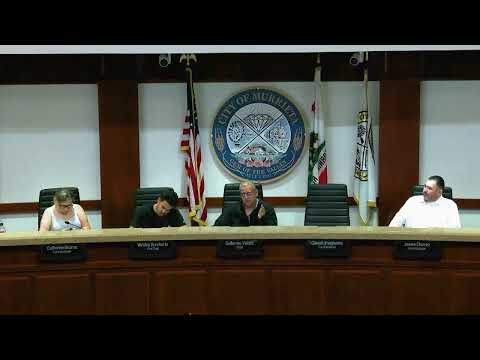
The Murrieta Traffic Commission voted unanimously June 17 to install an all‑way stop at the intersection of Los Alamos Road and Mason Avenue after staff presented warrant findings and sight‑distance measurements.
James Ozaf, senior civil engineer and traffic‑commission liaison, and consulting traffic engineer Brian Stevenson told commissioners that, under the California Manual on Uniform Traffic Control Devices (MUTCD), stop controls are warranted primarily by traffic volumes, collision history or sight‑distance constraints. Stevenson said intersection volumes did not meet the MUTCD volume warrants and the police collision history showed zero reported accidents at that intersection over the last 10 years. The primary concern, he said, was limited sight distance on the east approach: the measured sight distance there was about 315 feet compared with the 495 feet required for a 45‑mph approach.
Stevenson said shrubs and a utility pole on the curve reduce visibility and that trimming efforts begun in 2019 have been difficult to maintain. Because of that constrained sight line and the rural, dark character of the approach, staff recommended an all‑way stop with advance pavement legends and stop‑ahead signs, plus solar‑powered flashing beacons (yellow approach beacons and red beacons at the stop) to increase nighttime conspicuity. Staff said the beacons would raise the installation cost compared with a basic stop control.
During questioning, commissioners asked whether the city would continue vegetation maintenance and how costs differed; staff said the city will continue maintenance but that vegetation can regrow faster than crews can trim it, and confirmed the solar beacons account for the higher estimate at this location.
Courtney Schumacher, who identified herself as a nearby resident, urged installation of the stop, saying she and her husband have lived near the corner for 12 years, have repeatedly repaired fence damage from vehicles, and are concerned about high speeds and limited visibility that endanger drivers, residents, horse riders and animals.
Commissioners discussed broader speed‑limit processes and temporary radar feedback signs. Staff explained enforceable speed‑limit changes require engineering speed surveys (the 85th‑percentile method) and council action, and noted the city deploys temporary radar signs on request and can collect enforcement data from them.
Commissioner Chavez moved to install the all‑way stop; Commissioner Burchcharts seconded. The motion carried unanimously. Staff will prepare the work order and return with implementation details; the transcript does not specify a construction schedule.