Get Full Government Meeting Transcripts, Videos, & Alerts Forever!
Get email alerts on the School Expansion topic
No spam. Unsubscribe anytime.
Deadlock leaves controversial James Island early‑learning addition unresolved after cemetery, traffic concerns
Summary
A 23,000 sq ft early learning center addition for James Island Elementary drew sustained public concern about traffic impacts and possible unmarked burials near Evergreen Cemetery; the Historic Preservation Commission deadlocked 4–4 on a deferral motion, so the item will return to the next agenda.
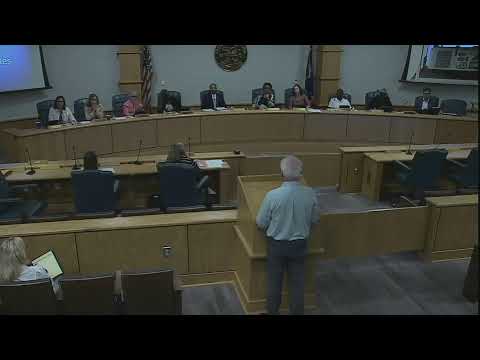
Chair Donna Gardner opened public comment and staff planner Monica Eustace presented the county’s recommendation on a certificate of historic appropriateness for a 23,000‑square‑foot, one‑story early learning center addition at James Island Elementary (TMS 334‑07‑0000‑47‑1872). Staff noted the project lies within 300 feet of the National Register‑listed W. G. Gresham Megot High and Elementary School and described required site work: new playgrounds, 66 required new parking spaces plus 40 overflow grass spaces, improved circulation and stormwater work. Staff also summarized prior approvals: conditional site plan review and a June 1 BZA decision permitting removal of three grand live oak trees while requiring protection for tree #7 with limited root intrusion.
Applicant representatives said the addition would have capacity for 200 students (an increase of about 170 students beyond those already housed on site), 32 staff and an extended on‑site stacking loop rising from about 1,900 to 3,000 feet so more cars can queue on campus rather than on South Grimble Road. Chris Cook, the engineer, said buses and staff traffic will use a new rear driveway and parents will use the extended drop‑off loop; Jasmine Shaw, the district’s executive director of capital, said the addition is intended to serve hundreds of early learners countywide and that the district needs the approval to proceed with construction.
During public comment, residents and community groups expressed two consistent concerns. Several neighbors said they had not received adequate notice, described persistent stacking and speeding on South Grimble and Folly roads, and questioned whether the site can safely accommodate hundreds more daily car trips. Elizabeth Singleton said the district should consider alternative, vacant schools instead of expanding on the James Island site. Neighbors and the Grimble Area Improvement Association also asked how construction and long‑term traffic would be managed so that local streets are not further burdened.
The Preservation Society and multiple residents raised a second, distinct concern about Evergreen Cemetery and the potential for unmarked burials near the project’s southeastern boundary. Sam Spence of the Preservation Society told the commission a 2022 ground‑penetrating radar (GPR) study by Clemson students identified numerous unmarked burials near Nathaniel Drive and urged a targeted GPR survey and documentation prior to ground disturbance. Residents asked for a protocol to identify and protect unmarked graves and for confirmation that recent drainage or landscaping work has not disturbed burial sites.
County staff and the applicant said protective measures are incorporated in construction documents: the contractor must follow archaeological notification procedures, stop work if suspect remains are encountered, cordon off a 50‑foot area around a discovery, and notify the State Historic Preservation Office and the coroner. Staff and the county attorney, Natalie Ham, reiterated that state statutes apply to graves and that those laws govern how discoveries are handled. The applicant said existing archaeological surveys and limits of disturbance do not show graves within the permitted work area and that the most likely locations of previously recorded burials lie outside the active construction footprint; they said they would enforce stop‑work and notification procedures if anything is discovered.
Commissioners debated whether cemetery concerns were within the Historic Preservation Commission’s purview (the commission’s statutory review focuses on design compatibility). Several commissioners said they were uncomfortable voting without additional archaeological or traffic information. A motion to defer for further study was made and seconded; a roll‑call vote produced a 4–4 tie (Lisa Jones, Vice Chair German, Anna Johnson and Pat Jones voted yes; Commissioners Ford, Gardner, Gerard and Malar voted no). The motion failed on a tie. Under the commission’s procedures, because the motion to defer failed with a tie, the item will be automatically placed on the commission’s next agenda for review and consideration.
What comes next: the project remains pending. Staff and the applicant said routine statutory protections for discoveries would apply during construction, but several commissioners and many residents said they want clearer pre‑construction documentation (for example a targeted GPR survey in the zones neighbors identified) and additional traffic analysis or mitigation measures before the commission is asked to approve design details that could proceed to permitting and construction.