Get Full Government Meeting Transcripts, Videos, & Alerts Forever!
Get email alerts on the Temporary Street Closure topic
No spam. Unsubscribe anytime.
Planning commission denies Sugar Creek Foods’ request to regularly close Sea Street, asks traffic division to develop alternatives
Summary
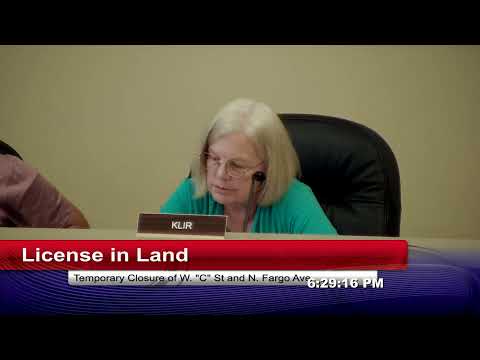
After lengthy public comment, the Russellville City Planning Commission voted to deny Sugar Creek Foods’ request to temporarily close portions of West Sea Street and North Fargo Avenue during business hours, instructing the city’s traffic division to propose traffic-calming alternatives such as stop signs, raised crosswalks and flashing lights.
The Russellville City Planning Commission voted to deny a request from Sugar Creek Foods to regularly close segments of West Sea Street and the northern half of North Fargo Avenue during weekday business hours, citing concerns about downtown circulation, notice to neighboring businesses and precedent.
Gavin, planning staff, had recommended a memorandum of understanding for a revocable license allowing limited closure from 8 a.m. to 5 p.m. Monday through Friday, with conditions including coordination with emergency services and utilities and a condition that the company cost-share 36% of road maintenance in the affected blocks. During the staff presentation Gavin said the license would be revocable and would not create an ownership interest in the public right-of-way.
The commission heard extended public comment before the vote. Scott Van Horn, a co-owner of Sugar Creek Foods, said the 80-year-old plant employs roughly 40 people, has received about $8 million in investments from current ownership and contributes an estimated $4.3 million annually to the local economy. Van Horn told commissioners that employees and forklifts cross Sea Street dozens of times per day and that his insurer had expressed increased safety concerns, prompting the request for temporary gates during operating hours. "If that plant closes, you're going to lose $4.3 million in local economy annually," Van Horn said.
Several neighboring business owners urged the commission to reject the closure, saying it would reduce walk-in traffic, risk property values and set a harmful precedent for downtown circulation. Tom Posey of Posey Printing, a longtime Sea Street business owner, said the proposal had not been adequately communicated to affected businesses and cautioned against altering the street network for a single business’ operational needs. "I just urge you to give it some serious consideration," Posey said, noting uncertainty about how closure would affect nearby businesses.
Other commenters offered data and alternatives. David Garza of Barrett Associates said traffic counts declined from about 1,000 vehicles in 2010 to roughly 640 in 2022, reflecting broader changes in how businesses and customers use downtown. Corey Miller of Refrigerate Electric Supply said three-quarters of his customers arrive from the Sea Street direction and suggested less disruptive measures — speed bumps, flashing crosswalk lights or a pedestrian-activated gate — to improve safety while preserving access.
Commissioners questioned whether private insurance decisions justify changing public rights-of-way and discussed operational alternatives, including equipment changes to accommodate raised crosswalks. After debate, the commission amended a denial motion so that the final action directed the traffic division (with input from public works and fire) to develop traffic-slowing measures appropriate to the location. The amended motion to deny the license and ask the traffic division to propose measures passed following a roll call.
Under the proposal described in the record, the license would have limited closures to weekdays, required the licensee to post clear signage, and made the license revocable. Commissioners who opposed the closure pointed to the city’s downtown master-plan goals for maintaining a connected grid and urged that traffic-calming be handled by the city's traffic professionals rather than by granting exclusive use of a public roadway to a private business.
The planning commission took no further business and adjourned. The record does not show a subsequent council action; the commission’s action was a denial with instructions to the traffic division to propose alternatives.