Get Full Government Meeting Transcripts, Videos, & Alerts Forever!
Get email alerts on the Land Use topic
No spam. Unsubscribe anytime.
Commissioners ask staff to explore Vere Hoff road alternatives after county designates nature preserve
Summary
An alignment study for the Vere Hoff connector prompted discussion after Mecklenburg County documents showed part of the planned route lies in a county-designated nature preserve; commissioners asked staff to develop alternatives that avoid or lessen impacts to the preserve and return with maps and options.
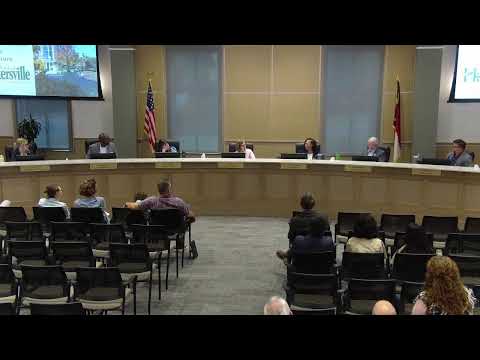
Huntersville received an update June 16 on the Vere Hoff alignment study and directed staff to develop additional route options after learning county records designate part of the property as a nature preserve.
Steven Trout, who presented the study to the Board of Commissioners, said the alignment adopted in 2002 remains partially unbuilt and that development and utilities since then — including Duke Energy lines and a gas transmission corridor — have changed conditions on the ground. He told the board that Mecklenburg County provided paperwork showing the county asked the state to designate a portion of the property as a nature preserve in October 2024 and recorded a Faira Town Nature Preserve dedication in April 2026. Trout said a known population of Georgia holly on the county property is of "significance" and that avoidance or mitigation should be considered.
"We had public involvement that generated mixed feedback," Trout said, summarizing two-week comment periods and a meeting with county staff. "Some said do not build a road in this area; others suggested alternatives such as widening Asbury Chapel Road or using the cleared power-line corridor." He also said a combined alignment that uses portions of previously drawn alternatives is under consideration.
Commissioners asked for additional work. Several members noted a cleared Duke Energy right-of-way north of the preserve that may reduce impacts to sensitive habitat if the alignment is shifted, and asked staff to return with options that would either avoid county preserve property entirely or materially reduce impacts. One commissioner emphasized that an adopted alignment is a planning reservation rather than a construction authorization: construction would require capital funding, design, property acquisition and permitting.
Staff estimated that building the entire discussed section today could cost "$50 million or more," but said more precise estimates would follow after design and property research.
The board did not vote on a final alignment at the June 16 meeting. Commissioners expressed a tentative consensus to pursue a variant of a northern (power-line) alignment and a second option that avoids the preserve, and to return with refined maps and analysis for further direction.