Get Full Government Meeting Transcripts, Videos, & Alerts Forever!
Get email alerts on the Land Use Rezoning topic
No spam. Unsubscribe anytime.
Maumelle Planning Commission advances land‑use changes for 173‑acre Sienna Ridge but defers formal rezoning after strong neighborhood opposition
Summary
The Planning Commission voted split recommendations on land‑use amendments for the proposed 173‑acre Sienna Ridge development and deferred the formal rezoning to March 26 after extensive public comment on apartments, traffic and drainage concerns.
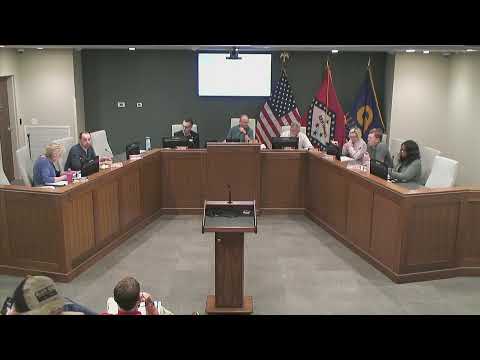
Maumelle’s Planning Commission on Feb. 26 recommended several land‑use map changes tied to a proposed 173‑acre project called Sienna Ridge but chose to delay action on the formal rezoning until March 26 after more than a dozen residents spoke against the plan.
Staff described the applicant’s concept — submitted by Epic Estates 3 LLC with Hallway Engineering as representative — as a mixed residential and neighborhood commercial project that would rezone land now split among C1, R1 and R2 to PRD (planned residential district) and PCD (planned commercial district). "This is a request involving approximately 173 acres," staff said, and warned that reszoning "does not approve final engineering"; staff estimated full buildout could generate about "3,859 daily trips" and recommended that intersection‑level traffic modeling and detailed drainage design be required at the development‑plan stage.
The nut graf: residents focused on the potential for apartments, traffic and downstream drainage, and asked how unit counts, road widths and buffers would be guaranteed. Citizens repeatedly said they felt the process was rushed and that zoning changes could permit higher densities later. "The apartments are an absolute no," one resident said. Another asked who would pay for additional police and fire services if the development increases demand.
Public comment ran nearly two hours. Speakers pressed staff to explain technical details and timelines, questioned inconsistent unit tallies that appear in staff materials, and urged stronger protections for existing single‑family neighborhoods. "If it gets zoned in a way that apartments would be allowed, then it's going to be very difficult to fight later down the road," one resident said. Multiple residents asked the commission to require a community meeting and clearer, plain‑language materials before a final zoning decision.
Applicant representative Roy Andrews described a concept with a mix of single‑family lots, townhomes, apartments and about 17 acres of neighborhood‑serving commercial. Andrews said the PRD approach is intended to preserve green space, provide trails and allow a coordinated master plan rather than a series of unrelated developments. He also said developers typically build proposed roads and that site grading and stormwater features would be addressed in the development‑plan and engineering phases.
Commissioners debated whether to postpone action for 30 days to allow additional outreach. A motion to defer the land‑use items failed on a 4–3 vote, but the commission approved roll‑call "do pass" recommendations on three of four land‑use amendments (two of the amendments passed, one failed) with conditions that further staff, engineering and commissioner comments guide the development‑plan review. The commission then voted to defer the formal rezoning application (RZ‑26‑1) to its March 26 meeting to allow additional information and community engagement.
What the votes mean: the commission's "do pass" recommendations advance the proposed land‑use changes to city council for final action; they do not by themselves change zoning. Any final zoning approval would be decided by the city council after additional public hearings and required readings.
Staff and several commissioners emphasized technical next steps: if the project proceeds, staff will require traffic intersection analyses, signal or turn‑lane mitigation where warranted, and detailed stormwater engineering to address downstream flooding concerns. Staff also said a community meeting tied to the development plan will be scheduled before a final plan returns to the commission, giving neighbors another formal opportunity to comment.
Closing and next steps: the Planning Commission closed the public hearing and set the formal rezoning review for March 26. City council will consider any land‑use or zoning changes after the commission’s recommendation and after required council readings. The meeting also included routine council liaison reports and a brief update that two new planning staff members will be joining the department.
(Reporting note: quotes and attributions come from the Feb. 26 Planning Commission hearing transcript.)