Get Full Government Meeting Transcripts, Videos, & Alerts Forever!
Get email alerts on the Data Centers topic
No spam. Unsubscribe anytime.
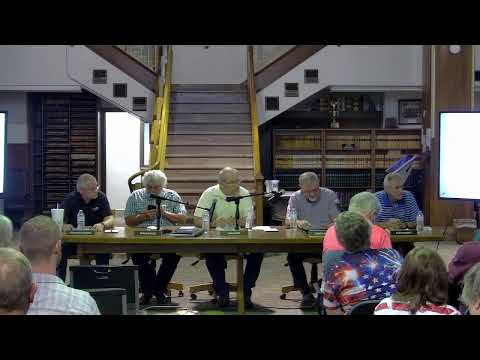
Reno County commissioners debate caps on data centers; motion recorded to ban centers larger than one acre
Summary
Commissioners debated whether to ban hyperscale or large data centers in the county's unincorporated zoned areas and discussed electricity, water and sound implications. A motion limiting data centers to one acre (non‑contiguous) was moved and seconded and a roll-call was recorded; one commissioner’s recorded vote was not audible in the transcript.
After discussing battery storage systems, the Reno County Commission turned to proposed data centers and whether the county should permit hyperscale facilities in unincorporated zoned areas.
Commissioners and speakers raised technical constraints: local electricity availability, water use for cooling, clustering risks, and noise/infrasound. One commissioner summarized national guidance that uses employment thresholds (about 20 employees) or megawatt thresholds to classify smaller operations and suggested a 100‑megawatt or similar cap as a possible local benchmark.
"Once you kick the door open, they cluster these things," a commissioner said when describing how large sites can multiply and create broader land‑use impacts.
Discussion ranged over possible tools: an outright ban, a moratorium to study issues, county-adopted regulations, or handling projects case‑by‑case through conditional‑use permits (CUPs). Staff and counsel explained that a CUP would bring individual applications to Planning & Zoning for public hearing and recommendation, while formal regulations would apply generally to any future applicant who met the criteria.
Several commissioners proposed numerical limits by acreage (two acres, one acre) and non‑contiguity conditions designed to prevent incremental expansion and clustering. A motion was made and seconded to ban data centers larger than one acre (non‑contiguous) in the unincorporated zoned area. Abigail, the clerk, called the roll: Commissioner Parks 'yes'; Commissioner Vincent (response not recorded in the transcript); Commissioner Winger 'no'; Commissioner Bogner 'yes'; Commissioner Hurst 'no'. The transcript shows at least two yes and two no votes with one commissioner’s vote not clearly recorded in the available audio/text.
Commissioners and staff acknowledged potential consequences for ordinary local server rooms and hospital or business data operations; several speakers said small data-serving operations are common and should not be unintentionally prohibited. Staff suggested any proposed standard could grandfather existing facilities and that Planning & Zoning could evaluate variances.
Next steps: the commission indicated the concerns and suggested thresholds would be given to the Planning & Zoning Commission for study and public hearings, and that any specific application would proceed through the planning process before the County Commission would take final action.
(For provenance: data-center discussion stretches from SEG 1249 through SEG 2110; final motion and roll call are recorded at SEG 1908–1933.)