Get Full Government Meeting Transcripts, Videos, & Alerts Forever!
Get email alerts on the Impact Fees topic
No spam. Unsubscribe anytime.
Smithville staff outlines steps and timeline to adopt impact fees; advisory committee must be reconstituted
Summary
At a June 16 workshop, Smithville staff said state law changes require the city to reappoint its capital improvements advisory committee with at least half the seats held by real estate/development/building representatives, complete the comprehensive plan/CIP and follow detailed notice and credit rules before adopting an impact-fee ordinance.
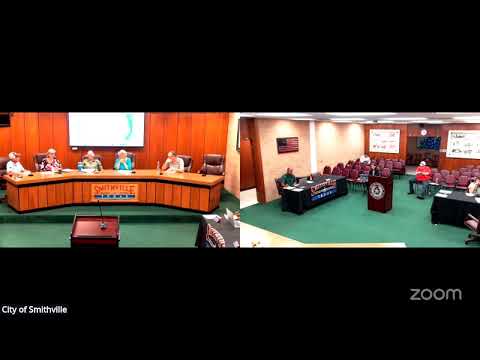
Smithville staff used a June 16 workshop to brief advisory members and the public on what the city must do to adopt an impact-fee program, including reconstituting the advisory committee under recent state changes and sequencing the work so the comprehensive plan and capital improvement plan (CIP) are adopted before any fee ordinance.
The presenter (city staff) told the committee that state law defines an impact fee as “a charge on new development used to pay for capital improvements or facility expansions that are needed because of that development,” and outlined eligible categories such as water supply and treatment, wastewater collection and treatment, stormwater drainage and roadway facilities inside the city limits. The presenter warned impact fees cannot fund routine operations or upgrades that serve existing development.
“It is informational. It is not action; there is no action required,” the presenter said, describing the session as educational. The presenter added that the program “definitely saves taxpayers money by having this as an option,” because fees can shift some capital costs tied to new development away from the general fund.
Committee reappointment and composition
Jimmy Jenkins said guidance from the Texas Municipal League (TML) and legal counsel makes clear the advisory board will need to be reappointed: at least 50% of committee members must be representatives of the real estate, development or building community, and those industry seats cannot be held by city officials. Current planning-and-zoning (PNZ) appointees must apply as private citizens if they wish to serve on the new advisory body.
Staff recommended using the term Capital Improvements Advisory Committee and examining other cities’ naming conventions to align with Senate Bill 1883. The presenter emphasized that the committee is a standing body that remains in place after adoption to provide ongoing oversight.
Process, timing and statutory requirements
City staff and the city manager said the comprehensive plan is essentially complete and Langford (the consultant) is scheduled to present to council; staff said council could adopt the comprehensive plan in July or August, at which point the connected CIP could be adopted. Those two documents—land-use assumptions and the CIP—are required to calculate impact fees.
Staff described the calculation process: land-use assumptions project growth over at least 10 years and convert land uses to service units; the CIP identifies needed improvements, capacity and estimated costs; the fee is the cost of needed improvements minus required credits (either developer-provided revenue or a flat 50% credit). Staff also said if a fee is adopted after land is platted, a property that receives a building permit within one year of adoption may be exempt from the new fee.
The presenter reviewed adoption procedures and notice: drafts and public availability windows, a hearing process that gives the advisory committee time to file written comments, and the requirement (under changes cited as Senate Bill 1883) that approval of an impact fee now requires a two-thirds supermajority vote of all council members.
Water conservation credits and ETJ rules
Staff pointed out a recent change requiring cities, beginning Jan. 1, 2026, to provide credits against water and wastewater impact fees when builders install improvements that produce measurable water reuse or conservation and thereby lower water demand or wastewater load; the city must adopt a procedure for granting such credits.
Staff also clarified geographic limits: roadway impact fees generally apply only within city limits, while water, wastewater and drainage impact fees may, in limited circumstances, extend into Smithville’s extraterritorial jurisdiction (ETJ). If the city elects to apply fees in the ETJ, the advisory committee must include a representative from that area; staff said the city will post applications and make a best effort to recruit interested ETJ property owners or prospective annexation candidates.
Public notice and recruitment
Jennifer (city staff) said applications for the new advisory committee will be posted online and on social media like other board recruitments. She said staff maintain a list of residents who have expressed interest in boards and will reach out if candidate numbers are low, but confirmed the appointment process must remain open to the public.
Questions raised and follow-up
Committee members asked whether fees could fund police, fire or schools; staff said routine operations (which likely include public safety) are generally excluded from eligible uses and offered to confirm the complete list in follow-up. Members also questioned how ETJ representatives would be identified; staff acknowledged there is no guaranteed method and said the city will use postings and known interest lists as a best effort.
The meeting concluded with no public comment on the item. A motion to adjourn was moved and seconded; the transcript does not record a roll-call tally or the final vote on that motion.
What comes next
Staff said they will return with additional research at a later meeting; the next critical steps are final presentation and adoption of the comprehensive plan and adoption of the CIP, after which work on a draft impact-fee schedule and ordinance would proceed. The presenter noted calendar alignment with the Oct. 1 fiscal-year start would be advantageous for implementation.