Get Full Government Meeting Transcripts, Videos, & Alerts Forever!
Get email alerts on the Public Comments And Scheduling topic
No spam. Unsubscribe anytime.
Building Code Council executive committee plans Tuesday work sessions to respond to 120+ public comments on code proposals
Summary
The SBCC Executive Committee said staff logged about 118 written comments and 53 oral testifiers and proposed a series of public Tuesday-afternoon work sessions starting in early July to draft responses and prepare a CR103 for final adoption at the Aug. 28 council meeting. Topics include embodied carbon, A2L refrigerants and multiplex housing.
The Washington State Building Code Council Executive Committee on June 17 said it will hold a series of public Tuesday-afternoon work sessions to review more than 100 public comments on proposed code changes and prepare responses ahead of the council's target final-adoption meeting on Aug. 28. "As a total, for written comments, we have 118, separate written comments," said Dustin Curb, SBCC managing director. "We're sitting somewhere in the range of 120 to 150, total comments to respond to."
Curb told the committee the largest clusters of comments addressed the embodied carbon appendix, International Mechanical Code (IMC) items including A2L refrigerants (proposals 112 and 113), and issues related to single-exit and multiplex housing. "First one's gonna be the embodied carbon appendix. Second on there is going to be the IMC, A2L refrigerants," he said. Committee members agreed grouping related comments by subject would help staff and council members prioritize review.
The sessions are intended as public work sessions — not formal full-council adoption meetings — where council members, tag participants and members of the public can deliberate and develop recommended responses or proposed code language to move back to the full council or to standing tags. "The intent is to make recommendations either back up to the full council to take action, or recommendations to have… engage from the tags," Chair Todd Beyreuther said. The committee discussed quorum considerations; staff said discussions could proceed without quorum but formal motions or official actions would require a quorum at a subsequent meeting.
Scheduling details were discussed: staff proposed holding the work sessions on Tuesday afternoons from about 1 to 3 p.m. over several weeks, and targeted Tuesday, July 7, as the first date to allow time to group comments and give members notice. "Then I'll, target then the, Tuesday, July 7th," Dustin Curb said. Members suggested publishing a tentative schedule tied to specific topics so stakeholders could plan to participate.
Stakeholder representatives at the meeting asked how the work sessions would relate to standing tags or committees. Patrick Hanks of the Building Industry Association of Washington asked whether the sessions would replace or supplement the tag process; Beyreuther and Curb said the sessions could either produce recommendations directly for the full council or be referred to tags for further work, depending on the topic.
Curb also clarified that energy-code work will follow a separate timeline: energy-code filing is targeted for July 1, hearings will run in September, and work sessions on the energy code are expected in October, with a later final-adoption target. "The energy codes are not going to be part of this comment process," Curb said.
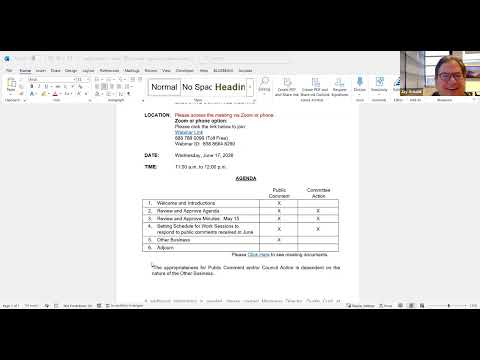
Before adjourning, the committee took two routine actions: it approved the meeting agenda and approved amendments to the May 15 minutes by voice vote. The committee adjourned with staff tasked to publish session dates and grouped topics and to proceed with drafting comment responses and any necessary CR103 language for the council's Aug. 28 meeting.