Get Full Government Meeting Transcripts, Videos, & Alerts Forever!
Get email alerts on the Data Centers topic
No spam. Unsubscribe anytime.
Residents urge pause on proposed data center expansion over water and environmental risks
Summary
Dozens of Freestone County residents urged commissioners to delay further phases of a planned data center and reinvestment zone, citing water use, chemical runoff, low-frequency concerns and skepticism about promised jobs; county leaders said many controls rest with state regulators and that tax-abatement contracts contain some conditions.
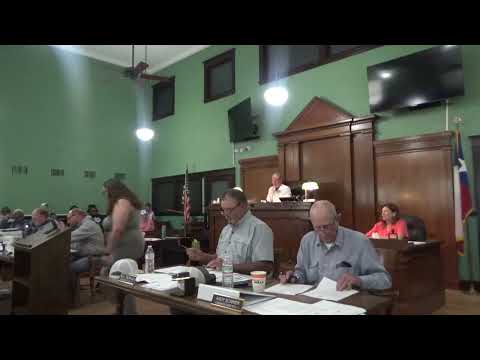
Dozens of residents told the Freestone County Commissioners Court on June 17, 2016, that they oppose further phases of a proposed data-center development and asked the court to pause new incentives and approvals pending independent studies. Speakers at the public hearing raised concerns about the project's water use, cooling chemicals and noise or low-frequency impacts, and questioned whether the county can enforce meaningful safeguards.
The hearing opened after outside counsel informed the court that the applicant CyrusOne had asked to be removed from the agenda, but county leaders kept the public hearing on the record so neighbors could register concerns. "I'm against it — we already have four," said Tanya Craig, a resident who told commissioners she was worried about low-frequency emissions and health impacts. Bruce Frigo, another resident, urged a temporary moratorium, saying the Calpine energy center servicing the area uses large volumes of cooling water and warning that multiple new data centers would add substantially to local demand.
Other commenters focused on contractual protections. Michael Sanderson said he had not seen the company's full agreement and urged the county to require clear, enforceable conditions in any tax-abatement deal, including closed-loop cooling and provisions that would revoke incentives if conditions were not met. "If at any point in time these conditions are not continuing to be fulfilled, the tax abatement goes away," Sanderson said, arguing the county can write terms to protect the community.
Speakers also pressed for more technical and emergency-planning details: bills of materials and certificates of origin for equipment, emergency-response and fire-suppression plans, monitoring for leaks and chemical disposal procedures. Opal Oliver, who said she sits on local water boards and answers to TCEQ, reminded the court that water systems and discharges are regulated by the Texas Commission on Environmental Quality and said that while construction jobs are real, sustained high-tech employment is often limited.
County officials told the hearing that the county's legal authority is constrained: the court cannot unilaterally impose a statewide moratorium and must rely on state agencies to enforce environmental and water-quality rules. A court spokesperson (the judge) noted that the existing tax-abatement documents on file include specific terms, and staff pointed to a minimum-job provision in the abatement (stated in the record) as one contractual lever: the abatement requires a minimum number of jobs per building and can be voided if contractual conditions are unmet.
The hearing closed after the public comment period; commissioners moved to end the public hearing with no immediate county action to block the project. County officials and multiple commenters said the next steps include compiling requested materials, continuing outreach to state regulators and considering additions to future abatement negotiations. The record shows strong local opposition focused on water, environmental and long-term economic concerns, while county leaders repeatedly cited limits on local regulatory authority and the need to work through contract terms and state oversight.