Get Full Government Meeting Transcripts, Videos, & Alerts Forever!
Get email alerts on the Transportation Tax topic
No spam. Unsubscribe anytime.
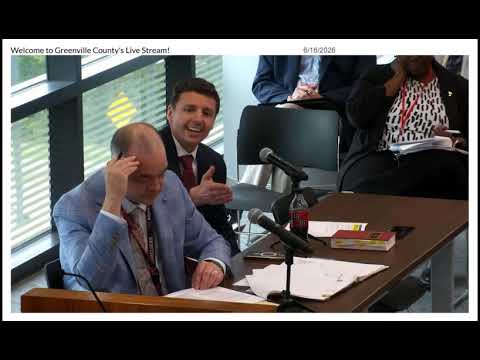
Greenville County Council approves transportation sales and use tax ordinance after amendments
Summary
After hours of debate over legal language, allocation splits and ballot presentation, Greenville County Council approved a transportation sales and use tax ordinance amended to cap receipts at $1.1 billion over eight years and to allocate 3% to Green Link transit and 7% to Green Belt conservation; the final vote was 10–2.
Greenville County Council’s Committee of the Whole voted 10–2 to approve a transportation sales and use tax ordinance amended on several points, including a $1.1 billion cap over eight years and specific shares for transit and land conservation.
The ordinance, as amended, directs the bulk of projected revenue to road and infrastructure projects, sets 3% of the proceeds for Green Link transit and 7% for Green Belt conservation, and clarifies statutory references and procedural controls for how outside entities request and receive funding. Council members debated both legal phrasing and political strategy before final adoption.
Why it matters: the ordinance creates a local sales and use tax dedicated to transportation-related projects and preservation efforts and will appear on the ballot as a capped package. If voters approve it, collections would begin the June following voter approval; the ordinance specifies a total cap and an eight‑year sunset so the program has both a dollar and time limit.
Key details and debate Council member Councelor McGee (mover of multiple redline amendments) said the edits were intended to avoid legal challenges and to reflect state law. He moved a string of technical and policy changes, including replacing the term “transit” with “transportation” in statutory text to align municipal enabling language and adding a statutory citation for a 20% reduction that affects municipal shares.
Mr. Price, a county staff presenter, explained the municipal reduction provision stems from recent state legislation (referred to in the discussion as Act S66): if a municipality in the county enacts its own transportation sales/use tax, state law requires that a portion of local receipts be returned against ad valorem taxes, effectively capping what a city may retain. “One of the differences between what is before you as the county transportation tax is 100% of the value is what you will be able to utilize,” Mr. Price said, while cities would be limited by the state-prescribed reduction.
Revenue cap and ballot language Council debated whether the draft should list a $1.5 billion cap (the higher projection cited earlier from the South Carolina Department of Revenue) or a lower $1.1 billion figure. Several members said the larger headline totals could alarm voters; legal staff advised the ordinance and ballot question must mirror each other and that the ordinance must state a total figure. The council amended the ordinance and ballot language to reflect a $1.1 billion cap and adjusted the percentage allocations accordingly.
Allocation fight and compromise The meeting featured extended negotiation over how to divide proceeds among roads, Green Link transit and Green Belt conservation. An 80/10/10 proposal failed on roll call. After more bargaining, council adopted an amendment setting allocations at 3% for Green Link and 7% for Green Belt (the remainder to roads) over the eight-year period; that amendment passed 10–2.
Budget and legal limits Legal staff and the county administrator clarified that the ordinance cannot itself replace current budgeted operating support; moving an existing budget line item or eliminating an existing appropriation would require a future separate budget action. Council members discussed whether a nonbinding resolution could express intent to shift funding in future budgets, but attorneys cautioned that future councils could change budget decisions.
Oversight, transparency and project selection The ordinance was amended to formalize a process requiring outside entities to submit annual funding requests to the county administrator, to route compiled requests and analysis to the Roads, Infrastructure and Public Works committee for recommendation, and to create a transparency advisory committee of citizens to review expenditures. Council expanded that committee to seven members and added the Greenville County Auditor as an ex‑officio voting member to strengthen oversight and public reporting.
Outcome and next steps The committee approved the ordinance as amended on a roll-call vote (10 in favor, 2 opposed). Council directed staff and legal to prepare the matching ballot language and allowed for further amendments at third reading if necessary to correct drafting or to ensure the ballot question mirrors the ordinance. If approved by voters in the referendum, collections would begin the June after passage and the county would use proceeds subject to the ordinance’s restrictions. The committee then entered an executive session on an unrelated contract matter and adjourned.
Representative quotes “...we don't want it to be challenged and after we get all the way across the finish line be challenged in court and thrown out because we have an error,” said Councelor McGee, explaining why staff redline corrections were necessary.
“[State law] would be required by that same statute to put 20% of any collected taxes against the ad valorem taxes that they would already collect,” Mr. Price said in an explanation to clarify municipal impacts.
“The statute requires placing a number into the statute. You cannot leave it open-ended,” a council member said during debate over the dollar cap on the ballot question.
What the ordinance does not do It does not itself change current budget appropriations; any replacement of property-tax funding with sales-tax proceeds would require a separate budget amendment. It also does not bind future county councils to a particular budget treatment; a nonbinding resolution can express intent but cannot legally bind future legislative budgets.
What to watch next The ordinance will be finalized for ballot language and returned at third reading for technical updates if needed. If the referendum passes, staff will present spending requests and project prioritization for the Roads, Infrastructure and Public Works committee and the transparency committee will begin quarterly reporting to council.
Ending Council approved the ordinance as amended and then moved into executive session to receive legal advice on the county administrator search firm contract; no action was taken in executive session.