Get Full Government Meeting Transcripts, Videos, & Alerts Forever!
Get email alerts on the Economic Development topic
No spam. Unsubscribe anytime.
Council approves Project OTT and Augusta Arbor II incentives amid criticism over jobs and tax breaks
Summary
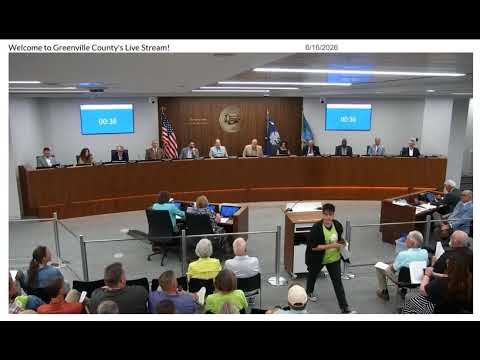
Council adopted resolutions and a fee-in-lieu agreement to certify Project On the Trail and to authorize a fee-in-lieu for Augusta Arbor II. Resolutions for Project OTT passed (9–2–1) and the Augusta Arbor II FILOT ordinance passed at third reading (10–2) despite public concern that the residential deal promises few jobs while granting a 30-year tax freeze.
Greenville County Council approved a sequence of economic development measures including certification under the South Carolina Textile Communities Revitalization Act and a fee-in-lieu-of-tax (FILOT) agreement supporting a $35 million residential project known in the agenda as Augusta Arbor II.
Councilman Collins presented the Project On the Trail (Project OTT) certification and a related special source credit agreement. Both carried on roll calls recorded as nine in favor, two opposed and one absent. Council members said the certifications and credit agreements were intended to enable benefits and incentives available under state law for textile-community revitalization projects.
Separately, the council adopted at third reading an ordinance authorizing a fee-in-lieu-of-tax agreement with BRI Augusta Arbor II QOZB LP related to a proposed $35 million development. Michelle Shera, speaking during public comment on item 9B, criticized the deal as a 30-year tax freeze that appears to promise zero jobs and shifts infrastructure burden onto existing residents. Shera urged council to avoid granting tax breaks when affordable housing and transit funds face proposed cuts elsewhere on the agenda.
Council members who supported the FILOT said such agreements are tools to attract investment and, where applicable, can spur job creation; supporters noted statutory limits and performance triggers, including occupancy thresholds, that can condition the incentive. Opponents and critics asked for more explicit job commitments and stressed transparent performance metrics.
Roll-call results recorded ten in favor and two opposed on the Augusta Arbor II ordinance. The resolutions and the ordinance now move forward under the terms of the agreements; council staff will proceed with implementation steps consistent with the fee-in-lieu and special source credit documents.
What’s next: Staff will return to execute the agreements and monitor any stipulated performance triggers; council discussion indicated it will track job commitments and occupancy thresholds tied to incentives.