Get Full Government Meeting Transcripts, Videos, & Alerts Forever!
Get email alerts on the Short Term Rental Regulation topic
No spam. Unsubscribe anytime.
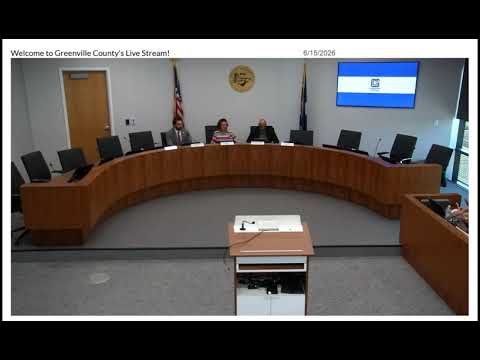
Greenville County committee reviews draft short-term rental licensing ordinance
Summary
The county's short-term rental ad hoc committee reviewed a draft licensing ordinance that would require online licensing, create a 60-day compliance window for existing operators, and tie enforcement to administrative fines or potential criminal penalties; parking, guest-age rules and data-retention raised implementation questions.
Greenville County’s Short-Term Rental Ad Hoc Committee spent its meeting examining a draft ordinance that would create a licensing system to identify short-term rental operators and provide a path to assessing an accommodations fee.
Staff member Chris opened the discussion by saying the goal was to compile community input into a single draft and “find a mechanism to identify the businesses or the people or whoever that were using or had short-term rentals,” and that staff intentionally proposed a licensing, not permitting, approach to align with the county’s software and administrative processes.
The draft would require an application and include a grace period for existing operators; staff suggested 60 days as an initial window for compliance. Chris said the licensing approach is consistent with actions taken in other counties, citing Charleston as an example, and that the licensing mechanism would enable later policy measures such as an accommodations fee.
Committee members asked detailed zoning and scope questions. Josh, participating by Zoom, said the intent is to treat eligible short-term rentals as single-family dwellings — not multi-family conversions — and clarified that “bed and breakfast are treated as conditional uses” in many residential zones while remaining permitted by right in commercial districts. Staff and members debated whether to allow partial-unit rentals (single rooms) or limit the ordinance to whole-dwelling rentals; staff warned that enforcing room-by-room rentals can be difficult and suggested handling boarding-house–type operations in a separate regulatory scheme.
The committee also discussed enforcement. Chris told members that prior reliance on civil penalties and code enforcement produced limited compliance in other County efforts, and that criminal sanctions have historically provided a stronger enforcement “stick.” He cautioned, however, that criminal penalties become legally complex when properties are owned by limited liability companies, and proposed the idea of designating a “natural person” — a named local contact — to preserve an enforcement target. Committee members broadly favored civil enforcement mechanisms with strong consequences (such as license revocation) but asked staff to research experiences from peer counties before pursuing misdemeanor penalties.
Operational details drew substantial debate. Staff proposed keeping fee levels off the face of the ordinance and instead adding them to the county’s administrative fee schedule so they can be adjusted annually. On operating standards, the draft raised a minimum guest age (staff used 25 as an example) and retention of copies of guest government-issued IDs for up to four years to support enforcement; members raised data-security and privacy concerns about that retention. Parking provisions in the draft call for designated off-street spaces for guests and, as written, prohibit on-street parking tied to a short-term rental use; members questioned enforceability and the expected load on sheriff’s office resources if parking limits were enforced in neighborhoods.
Staff asked the committee for direction on three items that would shape further work: (1) whether to pursue criminal penalties or a civil enforcement regime with graduated fines and license revocation for repeat violations; (2) how strictly to regulate partial-unit rentals versus owner-occupied arrangements; and (3) how detailed to make the application and parking requirements, given administrative capacity to review plans.
The committee did not take formal action on the draft ordinance at this meeting. The chair closed the session after asking staff to revise the draft based on the discussion and to consult with other county attorneys and enforcement agencies; the committee will reconvene to continue deliberations.