Get Full Government Meeting Transcripts, Videos, & Alerts Forever!
Get email alerts on the Enrollment Projections topic
No spam. Unsubscribe anytime.
Demographic study: Wayne schools could add hundreds of elementary students if planned housing is built
Summary
Consultants presented baseline and housing‑adjusted enrollment projections showing a baseline five‑year gain of about 240 students and an adjusted scenario (full buildout of proposed housing) adding roughly 1,262 students, with most growth concentrated in elementary grades and substantial budget and capacity implications.
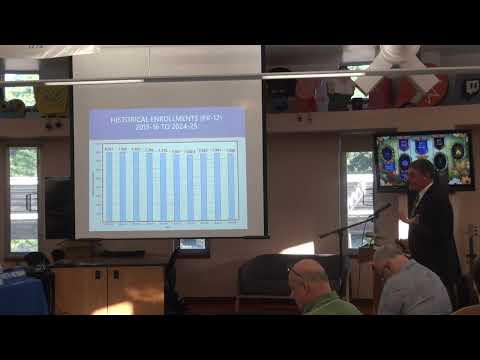
Dr. Richard Grip, executive director of Statistical Forecasting, told the Wayne Township Public School District board on May 28 that consultants project districtwide enrollment will rise over the next five years even without new construction, and could rise sharply if more than 3,000 proposed housing units are built.
"Enrollments are projected to increase in the next five years," Grip said, explaining the district’s baseline projection (which excludes new housing) and an adjusted projection that assumes full buildout of approved and proposed developments. The baseline scenario would add about 240 students districtwide by 2029–30; the adjusted scenario would add about 1,262 students, with most of the additional pupils concentrated at the elementary level.
The study uses the cohort survival ratio method, a commonly used, state‑sanctioned approach that calculates grade‑to‑grade progression and applies birth counts to estimate kindergarten yields. Grip said the team used birth data (462 births reported in 2023) and municipal planning information to allocate projected children to elementary attendance areas.
Consultants noted two drivers of projected growth: inward migration (10 of the study’s 13 grade‑progression averages exceeded 1.0, indicating net year‑to‑year gains) and planned housing. Grip listed more than 3,000 non‑age‑restricted units approved or proposed in Wayne, mainly multifamily developments concentrated in northern attendance zones; he cited the Toys R Us corporate campus redevelopment (about 1,360 units in the study’s buildout tally) as the single largest project but said no site plan had been filed for that site at the time of the report.
Public commenters and board members emphasized that the character of new units matters: the consultants used established multipliers to estimate children per unit and noted two‑bedroom market‑rate units yield fewer school‑age children than three‑bedroom units or detached single‑family homes. A public commenter said roughly 2,961 units had been approved, with roughly 1,800–2,100 two‑bedroom or larger units among them.
Board members and the district finance official discussed fiscal consequences. The finance official said pilot‑program agreements often route payments to municipalities rather than automatically providing funds to the school district; whether a pilot supplies district revenue depends on the specific agreement. The board noted that although state levy‑cap adjustments for enrollment increases exist, pilot projects commonly provide little or no direct district tax revenue, creating the situation of adding students without corresponding local tax receipts.
Board members raised operational concerns: some middle schools and elementary attendance zones could see disproportionate impacts if buildout is localized, transportation rules and costs constrain redistricting flexibility, and construction costs remain high. The board and consultants discussed options used elsewhere — adding classrooms, redistricting, and new construction financed by bond referenda — and noted each option carries tradeoffs including long timelines, political difficulty, and varying state aid for new capacity.
The board announced formation of a community school‑study committee to examine capacity, redistricting, and capital options and said further public forums will be scheduled in the fall after the committee’s work. The consultant recommended careful, near‑term planning because even a multi‑year buildout can create immediate classroom staffing and space needs that are costly to address on short notice.
The district will use the study as one input into capital planning and possible future referenda; the Department of Education expects recent demographic work when evaluating requests for school construction funding.