Get Full Government Meeting Transcripts, Videos, & Alerts Forever!
Get email alerts on the Data Center topic
No spam. Unsubscribe anytime.
Residents press Mercer County commissioners to require development contract, ballot question and recusal on hyperscale data center
Summary
At a Mercer County commission meeting, residents and experts debated a proposed hyperscale data center’s local impacts, with calls for a binding community development impact contract and a countywide ballot question; legal and acoustical issues were raised and staff said some studies so far are preliminary.
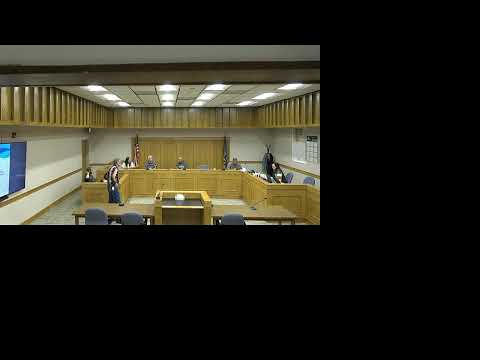
Mercer County commissioners heard extended testimony and technical briefing Monday on the potential local impacts of a proposed hyperscale data center, with residents urging a ballot question and legal safeguards and an acoustical engineer outlining how noise impacts would be modeled and mitigated.
Darwin Kudson, a Mercer County resident, told the board he is asking the commission to adopt a resolution placing the question on the November ballot: “Should Mercer County permit the construction of a hyperscale data learning center?” He asked that any approval be conditional on a binding community development impact contract to secure infrastructure investments, housing support for permanent employees and financial protections for taxpayers.
The request drew an immediate legal exchange. Todd, the county’s attorney, addressed the conflict-of-interest statute cited by Kudson (North Dakota Century Code 44‑04‑22) and related attorney-general guidance. Todd said the statute requires disclosure and recusal for direct or indirect pecuniary interests but explained that pension arrangements or prior employment do not automatically equate to a disqualifying direct pecuniary interest; he said the office would continue to advise the commission on specific disclosures and next steps.
Acoustical engineering and permitting context framed much of the technical discussion. Chris Kaiser, an acoustical engineer with AECOM, gave an overview of noise fundamentals, measurement weightings (A, C, Z), vibration concerns and predictive modeling practices (ISO 9613‑2). Kaiser described common mitigation options — changing equipment, adding silencers, and installing noise barriers — and said baseline surveys and early predictive modeling are typical at the preliminary permitting stage. “We build 3‑D models, draw in topography and equipment sound data, drop in receptor points and then predict dBA and frequency content,” Kaiser said.
Residents raised specific concerns about low‑frequency tonal noise (C‑ and Z‑weighted effects), noting these frequencies can be felt as pressure even when not perceived as loud. Tara Dukart, who lives near the proposed site, thanked Kaiser for noting both dBA and C/Z considerations and asked whether the developer had input into draft ordinances; Dukart said protections for residents living close to the site must be strong. Kaiser clarified that his team was conducting preliminary studies for the Riverrun Energy Center (a separate but related project) and that acoustical studies for a final data‑center layout would be refined as design details become available.
Commissioners and staff also discussed taxation and fiscal effects. Presenters said data centers are typically locally assessed (unlike some centrally assessed utilities), and speakers emphasized that property‑tax analysis captures only part of the fiscal picture: construction payroll, supplier multipliers and sales taxes also matter. A tax‑office staffer (Claire) said detailed allocation questions — for example, how Rough Rider handles metering and distribution of charges — are handled by the tax department and utility procedures; she declined to provide firm allocation numbers during the hearing.
What happened next: commissioners approved a number of routine agenda items during the same meeting (see separate writeup). On the data center topic the commission did not adopt a ballot resolution at this meeting; the county attorney and commissioners agreed to review legal options and the recorder’s office and staff said additional ordinance and environmental review work will continue. The planning and zoning office has scheduled a public hearing on related land‑use drafts for June 24.
Why it matters: A hyperscale data center would be a significant industrial project with long‑term tax, land‑use and community‑services implications. Residents’ requests for a binding community development impact contract and explicit recusal guidance reflect concerns about how benefits would be distributed, the sufficiency of environmental protections (noise among them) and whether conflicts among local decisionmakers are properly disclosed.
Next steps: County staff and the attorney will continue to research legal options and recusal rules; planning and zoning has a public hearing scheduled for June 24 on related ordinance and map changes, and the commission suggested bringing a refined public comment policy and any ordinance drafts back for further public review and possible vote.