Get Full Government Meeting Transcripts, Videos, & Alerts Forever!
Get email alerts on the County Budget And Services topic
No spam. Unsubscribe anytime.
Ashland County committee hears staffing strains and funding shortfalls as 2027 budget hearing opens
Summary
County Health & Human Services department heads described staffing shortages, program limits and small grant allocations as the committee opened a public hearing on the 2027 budget; no public testimony was received during the hearing's initial session.
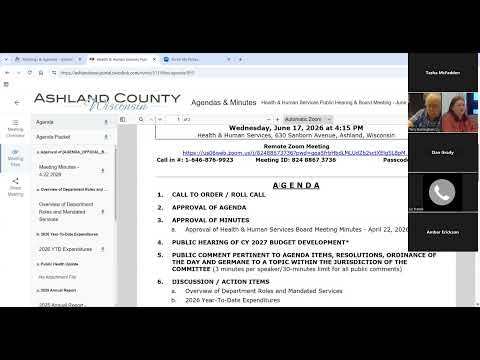
Acting Chair George Buset convened the Ashland County Health and Human Services Committee at 4:15 p.m. June 17 and opened a public hearing on the county—s 2027 budget, then recessed the hearing to continue regular business after no immediate public testimony.
Department managers used the committee—s regular agenda to summarize mandated services and flag resource gaps that will shape next year's budget discussions. Erica Paido, manager of the Children and Families unit, outlined core child-protection duties under Wisconsin statutes and said the unit prioritizes keeping children with family when safe, using kinship placement and subsidized guardianship to avoid foster placements when possible. Paido and other staff said recruiting and retaining caseworkers is a persistent problem, and staff cited intake numbers and out-of-county placements for high-needs children as evidence of capacity limits.
The committee heard similar resource concerns from other divisions. Tasha (adult services) said the county—s Aging and Disability Resource Center and Adult Protective Services remain thinly staffed; she reported that in 2025 a single APS worker handled 96 investigations, seven new guardianship petitions and 43 annual protective placement reviews. Amy, economic support supervisor, said county staff determine eligibility for BadgerCare, SNAP and child-care subsidies and that interpreter services are provided through a regional consortium. Kelly B. summarized Title IV-D child-support enforcement functions, noting warrants are effective only inside Wisconsin.
Public health director Liz Kobachi said Ashland is classified as a level-two health department under DHS 140 and state statute 251.05 and must provide a long list of services. She told the committee most programs are "largely unfunded," citing formula allocations: $3,200 annually for communicable disease control, roughly $7,514 this year for immunizations (a formula change will reduce that by about $2,000 next year), about $4,183 for lead-related environmental monitoring, and roughly $10,000 for maternal-child health that requires a 60% match. Kobachi said Medicaid reimburses about $800 for a full lead-risk assessment though fieldwork and clearances commonly take multiple staff-hours.
Committee members pressed staff on where the gaps most affect operations. Paido and others said the county's limited levy and stagnant funding force reliance on creative placements and regional partners, and that neighboring counties often pay higher wages, complicating recruitment. Several members said budget discussions should consider making proven programs sustainable beyond short-term grants.
The hearing remained open; the committee planned to reconvene public testimony later in the meeting, then closed the hearing after the regular-business session and set the next committee meeting for Aug. 19, 2026 at 4:15 p.m.