Get Full Government Meeting Transcripts, Videos, & Alerts Forever!
Get email alerts on the Grant Process topic
No spam. Unsubscribe anytime.
Baltimore Community Reinvestment and Repair Commission outlines review process, conflict rules ahead of grant decisions
Summary
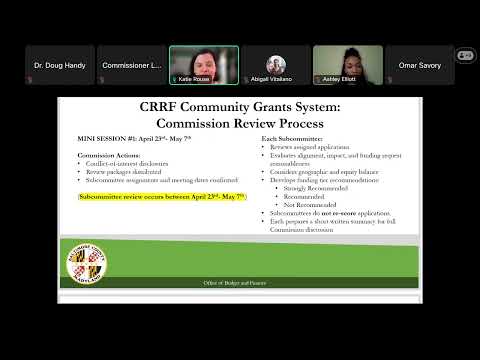
At a working session, the commission reviewed Open Meetings Act guidance, set expectations for subcommittee reviews and conflict-of-interest recusal, and urged commissioners to schedule subcommittee meetings before the May 7 full commission vote.
The Baltimore Community Reinvestment and Repair Commission held a working session to prepare commissioners for upcoming application review and to reinforce Open Meetings Act requirements, program staff said.
Chair (role title) opened the meeting and emphasized that tonight’s session was for information gathering only and that no votes would be taken. Program administrator Ashley Elliott confirmed a quorum and walked commissioners through procedures for subcommittees, access to application materials, and documentation practices.
Why it matters: Commissioners will recommend which applicants move forward to the county for final awards. Staff said more than 50 applications were submitted and that requests across applicants totaled roughly between $6 million and $10 million, meaning the commission will face choices about how to allocate limited funds.
Staff reviewed rules for subcommittee work and public meetings under the Open Meetings Act, advising that substantive discussions about applicants take place in scheduled public meetings rather than privately or by text. Elliott said subcommittees are for “information gathering” and will surface questions and clarifying details for the full commission, which will make final recommendations at a later meeting.
Commissioners discussed how to flag and handle conflicts of interest. Elliott said members who discover a conflict must recuse themselves from the review of that application, document the recusal with staff and, for virtual subcommittee meetings, leave the discussion when the affected application is considered. A commissioner clarified that recusal includes not participating in the discussion or vote on that application.
The commission also discussed recommendation categories to communicate relative funding priorities: “strongly recommended” for proposals that need no changes, “recommended” for programs that may need adjustments in size or scope, and “not recommended” for proposals considered a poor fit. Staff confirmed the county may request updated budgets if award amounts are changed after recommendations are made.
County staff cautioned that increasing award amounts for some grantees can change recipients’ tax or audit obligations and urged consistent standards across subcommittees. Commissioners agreed to aim for consistent documentation of why a proposal would be recommended at a different funding level.
Before adjourning, commissioners were urged to schedule subcommittee meetings promptly so reviews can be completed ahead of the full commission meeting scheduled for May 7.