Get Full Government Meeting Transcripts, Videos, & Alerts Forever!
Get email alerts on the Local Funding topic
No spam. Unsubscribe anytime.
County engineer briefs Princeton council on new state wheel-tax rules and funding trade-offs
Summary
Gibson County engineer Matt Holden told the Princeton Common Council the state's changes to the Local Option Highway User Tax (LOHUT) alter how municipal wheel and excise taxes interact with county levies and with Community Crossings distributions; he outlined deadlines, potential revenue ranges for Princeton, and trade-offs for local projects.
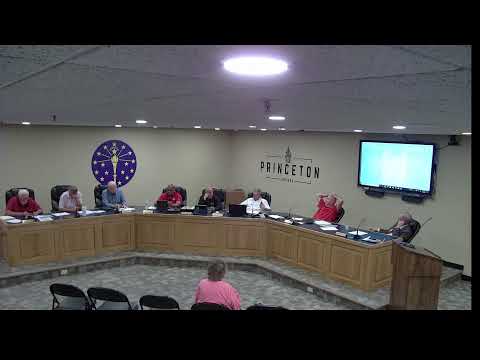
Matt Holden, Gibson County engineer and highway superintendent, explained to the Princeton Common Council on June 15 that recent state legislation bundles municipal wheel and excise taxes into a Local Option Highway User Tax and changes how those municipal levies interact with existing county collections.
"LOHUT is a local option highway user tax which includes wheel tax and excise tax," Holden said, adding that a municipality must adopt both components together. He said the county has collected a wheel/excise levy since 1983 and that the city of Princeton currently receives about $29,000 a year through the county distribution but could receive substantially more if it adopted its own LOHUT.
Holden walked members through allowable rate ranges, vehicle categories (passenger vehicles, motorcycles, larger trucks and RVs) and said municipalities can set separate rates by vehicle class. He estimated Princeton's direct distribution could range from about $60,000 to $200,000 annually depending on rates chosen, and gave a rough lane-mile distribution estimate near $100,000 under some scenarios. He cautioned those were estimates based on 2023 BMV data and subject to legislative and funding changes.
One key change Holden highlighted: when a municipality adopts its own LOHUT it generally will no longer "stack" on top of a county levy, so residents would not pay both city and county LOHUT in the same year under current rules. Holden said the state also altered Community Crossings grant calculations so localities that adopt LOHUT can become eligible for a noncompetitive direct lane-mile distribution; municipalities that miss the May 1 submission window become eligible only in the next cycle and must instead apply to the competitive grant pool.
Holden noted larger fiscal pressures statewide: recent gas excise-tax suspensions and changes to the Community Crossings program have reduced expected transfers, and the state has cut projects, increasing competition for grant funds. "We're going to see cuts directly on MVH and LRNS from the gas tax and excise tax suspension," he said, adding that changes to vehicle fleet fuel efficiency also reduce fuel-tax revenue.
Council members asked about timing and deadlines. Holden said municipalities must submit LOHUT ordinances and related materials to BMV by Sept. 1 to take effect Jan. 1 of the following year; the May 1 deadline for direct lane-mile distribution had already passed for this year, making Princeton ineligible for direct distribution in 2026 for municipal adoption now.
Holden said several local governments have publicly resisted LOHUT adoption and warned that significant public outreach will be necessary if Princeton considers an ordinance. He recommended additional council briefings and outreach before any formal action.
The council did not adopt an ordinance at the June 15 meeting; members said they plan further discussion and public engagement before any vote.