Get Full Government Meeting Transcripts, Videos, & Alerts Forever!
Get email alerts on the AI Policy topic
No spam. Unsubscribe anytime.
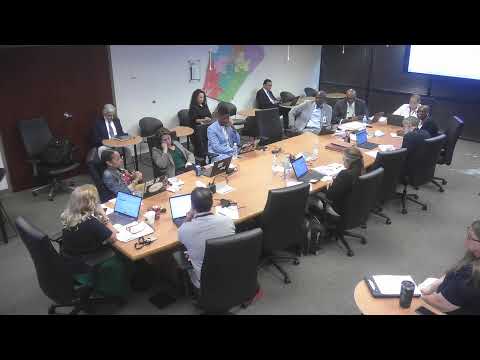
Wake County policy committee begins detailed first-reading of artificial intelligence policy amid pending state law
Summary
Committee members reviewed a substantially revised draft AI policy, discussed definitions, privacy safeguards and a district position against using automated AI-detection tools for grading, and noted DPI and legislative deadlines that may require future updates.
Wake County policy committee members on Thursday conducted a lengthy first-reading discussion of a new district artificial intelligence policy and the state legislation that is driving it, focusing on definitions, data privacy, teacher oversight, training timelines and whether the district should rely on automated AI-detection tools.
Dr. Crane, who led the presentation, framed the draft as the product of multiple sources and prior committee feedback. He described five broad elements the staff and working group considered: detector guidance for families, ethics and moral responsibility, whether to separate staff and student policies, grade-band differentiation for students, and bias mitigation/audits and oversight structures. He told members the draft expanded the scope to "artificial intelligence" rather than limiting it to "generative AI" and added definitions for AI, AI tools, generative AI, AI literacy and AI fluency.
The policy discussion occurred in the shadow of House Bill 301, which staff summarized for the committee. Under the version presented, the Department of Public Instruction would publish a model AI policy by Dec. 31, 2026; local boards would be required to adopt an AI-use policy by June 30, 2027; the state board would revise K–12 computer science standards to incorporate AI literacy; and the Friday Institute would develop educator/administrator training to be available by June 30, 2027 with completion by teachers required by June 30, 2028.
On detectors and academic integrity, the draft states—and staff reaffirmed at the meeting—that the district "does not support the use of AI detection programs due to their technical unreliability, inaccuracy, and potential for bias against specific student populations, including those for whom English is a second language." The committee discussed that position and emphasized a human-in-the-loop approach: teachers should remain responsible for confirming grades and evaluating student work.
Privacy, vendor vetting and approved-tools lists were also central. Technology staff described the district’s vendor-security review, contract specifications and insurance requirements; the draft directs that approved district tools comply with applicable law and contract terms and that district accounts and agreements will prevent use of student data to train third‑party models where contracts prohibit that practice. Several board members and staff recommended linking the policy to a publicly viewable, frequently updated list of district‑approved AI tools rather than embedding a static list in board policy.
Committee members asked for clearer language on developmental and grade‑band guidance (K–5, grades 6–8, 9–12), stronger statements addressing non-consensual intimate imagery (NCI) and AI-generated harassment, and a description of the oversight role staff envision. Dr. Crane acknowledged the current draft does not yet include formal auditing or a standing oversight committee but proposed inserting a requirement to create or assign oversight functions in a subsequent administrative regulation or R&P.
What’s next: staff asked that board members take the draft to their BACs this fall, refine it with community input and return a revised draft to a work session; the committee signaled a desire to adopt a policy sooner than the state statutory deadlines but expects to revisit language once the DPI model and any enacted statute are final.