Get Full Government Meeting Transcripts, Videos, & Alerts Forever!
Get email alerts on the Budget Fees topic
No spam. Unsubscribe anytime.
State Water Board staff outline 9.5%–16.6% fee scenarios to stabilize Safe Drinking Water Account
Summary
State Water Resources Control Board staff told stakeholders the Safe Drinking Water Account faces a structural gap and presented three options for FY26–27: no fee change (projected $7.6M deficit), a 9.5% increase (Scenario A) and a 16.6% increase (Scenario B) to restore reserves.
State Water Resources Control Board fee staff presented three revenue scenarios for the Safe Drinking Water Account to stakeholders, saying the account faces a structural gap that will require either fee increases or the use of reserves.
"We're looking at basically needing about 9.5% in additional revenue," said David Chuckelli, Fee and Revenue Branch Chief, describing Scenario A as a glide path that would preserve a roughly 26% reserve. Staff said an alternative — Scenario B — would raise about 16.6% across all water systems to fully balance projected FY26–27 revenues and expenditures and keep reserves near current levels.
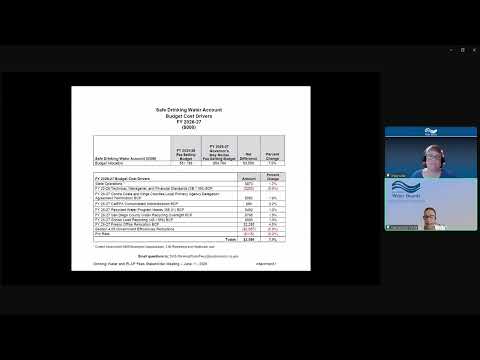
The presentation showed FY24–25 revenues of roughly $48 million and expenditures of about $38 million, producing a stronger reserve heading into FY25–26. Chuckelli said projected FY25–26 reserves are about $17.4 million (roughly 36–37% of annual expenditures) but that anticipated program growth and new responsibilities will push expenditures above current revenue levels.
Staff also noted that a change to the disadvantaged-community (DAC) fee structure — which would expand reduced-fee eligibility for certain systems — is expected to reduce fee revenue by about $2 million under modeling assumptions. Under a "no fee change" scenario combined with that DAC adjustment, staff projected a roughly $7.6 million deficit that would bring the reserve down to about 18% of annual expenditures.
Stakeholders debated timing. "Scenario zero is probably a good one," stakeholder Bob Gore said, urging no change this year and arguing an 18% reserve would be defensible. Other participants, and staff, warned that forgoing increases now could require a larger, more disruptive increase later. "If we select that option... you can guarantee a bigger fee increase coming up," one stakeholder said, endorsing Scenario A as a smoother path.
Why it matters: the board's choice affects fee payers statewide and the program's ability to absorb new regulatory responsibilities (for example, administration for recycled water, county primacy changes, and office relocations identified in BCPs). Staff framed Scenario A as balancing fiscal stability with smaller immediate impacts on ratepayers, while Scenario B would better preserve long-term reserves.
Next step: staff said they will continue stakeholder outreach; the next fee stakeholder meeting is scheduled for July 31 and the board process is expected to begin in September.