Get Full Government Meeting Transcripts, Videos, & Alerts Forever!
Get email alerts on the Public Safety topic
No spam. Unsubscribe anytime.
Wenatchee and East Wenatchee explore trial to share a police chief; no action taken
Summary
Mayors and police chiefs presented a proposal for an interlocal agreement to share one police chief, modeled at a roughly 68%/32% cost split and a $197,500 top‑step salary basis; councils were briefed in a discussion‑only workshop and asked for follow‑up and legal review.
Wenatchee and East Wenatchee mayors on Tuesday presented an informational plan to contract one police chief to serve as the head of each city’s police department under a trial interlocal agreement, but both councils took no formal action.
Mayor Crawford opened the joint special meeting and said the discussion was for information only. "We are not anticipating taking any action tonight; this is just for discussion purposes," she said, framing the proposal as one of several regional partnerships the two cities have pursued.
Edgar Rheinhold, chief of the Wenatchee Police Department and the city’s interim administrator, described the proposed operating model: Wenatchee would contract with East Wenatchee for chief services under an interlocal agreement while each department would remain a separate agency. Rheinhold said an initial cost allocation model split the chief’s compensation roughly 68 percent to Wenatchee and 32 percent to East Wenatchee, using a top‑step chief salary figure of about $197,500 per year as the basis for the calculation.
Under the plan the shared chief would be the department head and appointing authority for each agency, but each mayor and council would retain control over their respective departments and any policy or scope changes would require both governing bodies’ agreement, Rheinhold said.
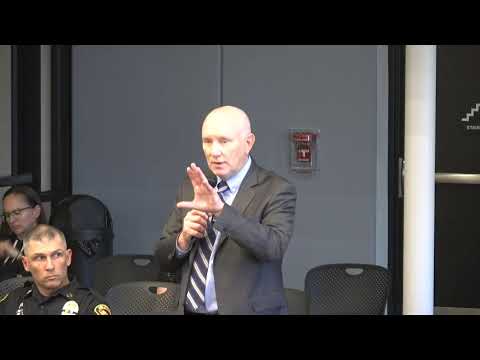
Steve Strachan, executive director of the Washington Association of Sheriffs and Police Chiefs, told the joint audience that while the proposal is "innovative," it is feasible and consistent with trends in local governments seeking efficiencies. "This is the kind of good government people are looking for," Strachan said, noting the approach depends on strong relationships and clear interlocal terms.
Mayoral presenters said the cities would aim to try the arrangement on a temporary basis. One speaker described the concept as a trial through the remainder of 2026 into the end of 2027, with interlocal agreements drafted by city attorneys and explicit exit provisions so either city can discontinue the arrangement unilaterally.
Councilmembers and staff asked detailed operational questions, including whether captains would run day‑to‑day operations, how labor contracts and differing accreditation cycles would be managed, and whether existing East Wenatchee grants or public safety sales tax revenues would be affected. Presenters said captains would manage daily operations within their cities, that the trial would surface labor and accreditation issues to be worked through, and that East Wenatchee’s dedicated sales tax and grants would remain with East Wenatchee.
Several police leaders and captains spoke in favor of the trial, including Captain Chance and Captain Brian Miller, who said they supported the experiment and cited long working relationships between agencies as a foundation for success. Some councilmembers raised community concern that East Wenatchee might be absorbed by Wenatchee; presenters repeatedly emphasized that the interlocal agreement would preserve each city’s governmental control and that any expansion of authority would require approval by both councils.
No vote or formal action on the proposal occurred at the workshop. Leaders encouraged councilmembers to submit follow‑up questions in writing, said final ILAs would be reviewed by each city’s attorneys, and estimated that, if pursued, the approval and negotiation process could take roughly 45 to 120 days.
The meeting concluded with a motion to close; the councils recorded the motion as carried by voice vote.
What’s next: city leaders said they will compile council questions, pursue legal review and, if both councils agree, bring completed interlocal agreements back for formal consideration and vote.