Get Full Government Meeting Transcripts, Videos, & Alerts Forever!
Get email alerts on the Water Quality topic
No spam. Unsubscribe anytime.
Residents press Las Cruces officials to strengthen lead‑service‑line inspections
Summary
Several residents told the City Council they believe Las Cruces Utilities’ current meter‑box inspection technique misses lead and galvanized service lines and asked the city to adopt EPA‑recommended methods, provide transparent answers to a previously submitted list of questions and explain how state grant money is being spent.
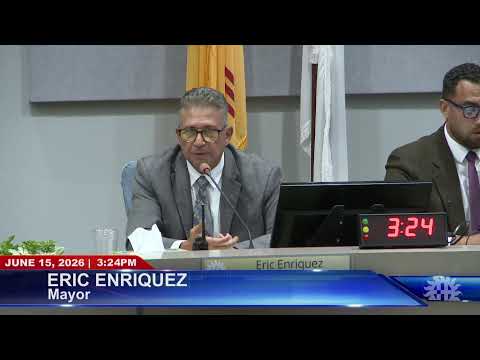
Dozens of public commentators pressed the City Council on June 15 to provide clearer, more aggressive action to identify and replace potentially hazardous water service materials, alleging the utilities department relies on a limited “meter‑box” visual inspection that can miss lead and galvanized piping.
"They're trying to get by doing the least amount possible," said Lynn Moya during the public‑comment period, arguing the city’s meter‑box technique is “deficient” and cannot detect lead or galvanized piping farther up the line. Moya and other speakers pointed to a 2023 EPA‑commissioned study that lists multiple inspection methods — including vacuum excavation, mechanical potholing and targeted sequential sampling — and asked why Las Cruces uses only visual checks.
Another long‑time commenter, Liz Rodriguez Johnson, said petitioners submitted a packet of 41 questions and five formal requests in December 2025 and had received no substantive responses. She asked councilors to account for how the city's reported work aligns with the state’s $15 million funding commitment and why property owners allegedly found to have galvanized pipe were not notified.
Council members did not immediately offer a policy change during public comment. Later in the meeting a council member summarized communications from Las Cruces Public Schools indicating that a December 18, 2025 field inspection at Fairacres Elementary documented no galvanized materials on either the city or customer service lines. The record supplied by the school was cited as evidence that some public claims require verification. The council did not take a vote on policy changes that night.
Assistant Utilities Director Dominique Rodriguez later described the city’s inspection program and the utility’s use of staffing and prioritized testing as obligations under the federal Lead and Copper Rule. She represented the utility’s normal practice for larger projects of pursuing state funding programs, including applications to the Water Trust Board, and said staff would continue to pursue engineering and testing options as they scope projects.
The public speakers asked for: (1) a complete, written response to the 41‑question packet previously submitted; (2) an explanation of how the $15 million state grant has been spent to date; (3) broader use of EPA‑listed investigation methods beyond meter‑box visual inspection; and (4) formal notification to property owners, including schools, if galvanized or lead piping is discovered. Council members agreed to follow up with staff; no formal policy or appropriation was adopted at the meeting.
The council’s exchange made a clear distinction between public concerns and the utility’s technical statements: citizens asked for independent confirmation and expanded testing, while city staff noted ongoing project scoping and state engagement. The next procedural step cited in meeting comments was staff follow‑up and further responses to public questioners rather than immediate changes to inspection technique.
Ending: The council did not adopt an immediate change to inspection protocols; speakers left the meeting urging written answers and faster transparency about testing and any notifications to affected sites.