Get Full Government Meeting Transcripts, Videos, & Alerts Forever!
Get email alerts on the Capital Policy topic
No spam. Unsubscribe anytime.
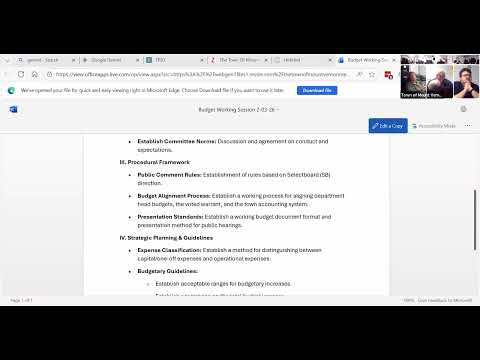
Budget committee debates capital vs. operating classification, considers $5,000 capitalization threshold and reserve use
Summary
Committee members discussed whether to classify projects above $5,000 or $25,000 as capital, reviewed examples (fire air packs, turnout gear, community center ramp, salt shed), and asked staff to prepare an accounting manual and clarify undesignated fund balances before final recommendations.
Mount Vernon’s budget committee spent a large portion of its meeting debating how to distinguish capital projects from routine operating expenses and how to fund multi‑year projects without spiking taxes.
Members listed common capital candidates — a new fire truck, replacement air packs and turnout gear, the community center ramp and stairs, and the salt shed — and discussed useful life and depreciation as key factors in classification. Committee members offered several numerical thresholds for the town’s capitalization policy, citing examples at $25,000, $10,000 and $5,000; several participants said $5,000 is a practical threshold for small organizations, subject to auditor guidance.
Speakers described how treating long‑life projects as capital and funding them from undesignated funds or a capital reserve can reduce the need to float bonds and smooth tax impacts over time. Committee members asked staff and auditors to confirm any existing capitalization policy and, if none exists, recommended drafting an accounting manual that includes a capitalization section and a recommended threshold for the select board to consider.
The meeting also examined undesignated/reserve fund balances. Members expressed confusion about how undesignated funds grew over time and requested a clear balance‑sheet reconciliation (FY24/FY25 audit information) showing carryover and designated reserve amounts. Revaluation and interim 'factoring' were discussed as timing issues that affect the mill rate and residents’ tax bills; staff noted factoring work will happen this year and a full reval takes many months to execute.
The committee asked Dorcas and other staff to prepare a short written recommendation the select board can use, and to provide clear figures on undesignated funds and municipal‑only percent changes before the next meeting.