Get Full Government Meeting Transcripts, Videos, & Alerts Forever!
Get email alerts on the Property Tax Relief topic
No spam. Unsubscribe anytime.
Mayor and Tax Collector Laura Caliguire outline new PSA‑1 combined application and timelines for property-tax relief in Clark Township
Summary
At a Clark Township town hall, Tax Collector Laura Caliguire explained the new PSA‑1 combined application that replaces separate PTR, Senior Freeze and Anchor forms, reviewed eligibility and income thresholds, gave filing deadlines and payment timelines, and described local help and identity‑verification steps.
Clark Township’s mayor and Tax Collector Laura Caliguire told residents at a town hall that New Jersey will use a single combined booklet, PSA‑1, for multiple property‑tax relief programs and urged eligible residents to prepare to file.
Caliguire said the PSA‑1 will replace the former PTR and Anchor forms: “this booklet is going to be one booklet it’s like a combined application,” she said, and the state will determine which benefits each applicant qualifies for. She advised residents that applications are available online now, that previously qualified PTR recipients will automatically receive a booklet with their base amount printed, and that the filing deadline for all three programs is Oct. 31, 2025.
Why it matters: the consolidation affects seniors, Social Security‑disabled residents, homeowners, mobile‑home owners and renters who rely on state property‑tax relief. Caliguire urged early filing because benefit checks are disbursed on different schedules and at least some funding for the new Stay New Jersey program depends on the state budget passing in June.
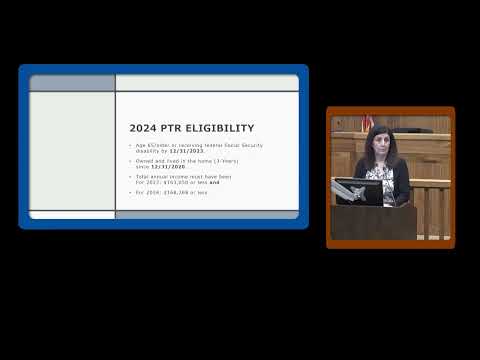
Key eligibility and amounts: Caliguire summarized program rules and examples. PTR eligibility requires that at least one household member be 65 by Dec. 31, 2023, or be receiving Social Security Disability; the presenter cited prior‑year gross‑income limits of about $163,050 for 2023 and $168,268 for 2024. Anchor eligibility is tied to residency as of Oct. 1, 2024, and income tiers; Caliguire gave sample Anchor payments of $1,750 for homeowners age 65 or older with gross income of $150,000 or less and noted smaller amounts for Social Security Disability recipients, renters and mobile‑home owners.
Stay New Jersey: Caliguire described the new Stay New Jersey program and said it would pay 50% of a qualifying homeowner’s property taxes up to a $6,500 maximum for applicants with New Jersey gross income under $500,000. She warned the benefit is subject to the state budget: “this is all contingent upon the budget being passed in June,” and said the state had signaled only partial upfront funding, meaning initial payments could be smaller until the budget is finalized.
Timing and payments: residents were told that, if funded, PTR payments will begin about July 15, 2025; Anchor payments about Sept. 15, 2025; and Stay New Jersey payments are scheduled in two installments (February and May 2026) for amounts the state initially commits to, with any remaining balance paid later if the budget allows. Caliguire demonstrated how the three programs could combine using a numerical example of a 67‑year‑old homeowner with a $9,500 base year tax bill to show how Anchor, PTR and Stay New Jersey amounts would interact.
Filing process and local assistance: the tax office ordered 200 PSA‑1 booklets for local pickup and expected them by mid‑March; staff said they would post notices, send email alerts and publish the presentation online. Residents can file online or print a PDF; those who filed PTR previously should wait for the preprinted booklet to capture their base amount. The town will offer an assisted computer at the tax window (outside peak tax periods) and recommended library computers as an additional option.
Identity verification and direct deposit: Caliguire explained that online filers who want direct deposit will likely need to complete ID.me identity verification and present primary and secondary identification (driver’s license, passport, Social Security card, etc.). She noted residents can still request mailed checks if they prefer not to use ID.me. For problems the state phone line and the regional Division of Taxation office in Cranford were offered as resources (Cranford walk‑in hours Mon–Fri 8:30 a.m.–4 p.m.; New Jersey Division of Taxation phone: 1‑888‑323‑4400).
Next steps: the town will notify residents when the PSA‑1 booklets arrive, make the recorded presentation available online, and provide in‑office help for people who need assistance completing or submitting the form. Caliguire encouraged residents to file early to receive checks according to the published schedules but reiterated that final Stay New Jersey amounts depend on passage of the state budget in June.