Get Full Government Meeting Transcripts, Videos, & Alerts Forever!
Get email alerts on the Convention Of States topic
No spam. Unsubscribe anytime.
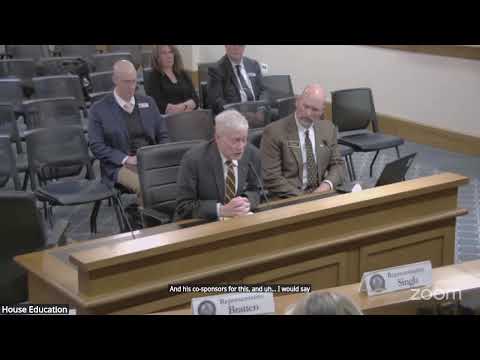
House Education Committee advances Article V convention resolution over broad public opposition
Summary
The House Education Committee voted to advance Senate Joint Resolution 5, an Article V application to call a convention of states on term limits, fiscal restraint and limiting federal jurisdiction, after testimony both supporting and warning against unpredictable convention rules; the measure passed the committee by a 5–3 margin with one excused.
CHEYENNE — The House Education Committee on March 2 advanced Senate Joint Resolution 5, a state application under Article V of the U.S. Constitution to call a convention of states that its backers say would allow states to propose amendments on term limits, fiscal restraint and limiting federal jurisdiction.
Supporters, including Julie Baker, state director of Convention of States, and Mark Meckler, the group’s president, told the committee the federal government has grown beyond its constitutional bounds and will not voluntarily restrain itself. Meckler argued state action is the only realistic path to major change, saying federal leaders “are not going to fix Washington, D.C.” and urging lawmakers to act to rein in what he described as unsustainable spending.
Opponents during the public-comment period pressed the committee to reject the resolution. David Iverson of Sheridan called an Article V convention “a very dangerous…idea,” warning that delegates could write their own rules and that state resolutions would not bind convention procedures. Margaret Herman of the League of Women Voters urged procedural safeguards—transparent proceedings, population-based representation and elected delegates—to prevent special-interest domination. Several online commenters reiterated concerns that a convention could be unrepresentative or stray beyond a single topic.
Committee procedure: Representative Singh moved to advance SJ 5, seconded by Representative Erickson. The clerk recorded five ayes, three no votes and one excused; the committee announced that SJ 5 passed and will move forward for further consideration, per committee rules.
Why it matters: An Article V convention requires two-thirds of states (34) to apply for Congress to call a convention; any proposed amendments would then require ratification by three-quarters of states (38). Advocates say a convention is a constitutional tool for structural reforms such as term limits and fiscal restraints. Critics warn the process is unpredictable because the Constitution lacks detailed procedures for convening or limiting the scope of such a convention.
What speakers said: Baker framed SJ 5 as a mechanism for states to propose amendments, emphasizing the 34-state threshold for an applications-based convention. Meckler emphasized perceived fiscal danger, citing national debt figures and arguing that elected federal officials lack incentives to limit their own power. Opponents insisted a convention could be hijacked by special interests or adopt rules that depart from state intentions, with the League of Women Voters specifically urging safeguards on representation and delegate selection.
Next steps: With committee approval, SJ 5 heads to the next legislative step in accordance with House rules. The resolution’s proponents and detractors signaled they will continue to press their arguments as the measure advances.