Get Full Government Meeting Transcripts, Videos, & Alerts Forever!
Get email alerts on the Parental Rights Enforcement topic
No spam. Unsubscribe anytime.
Senate Judiciary advances narrow parental-rights enforcement bill after hours of testimony
Summary
The Senate Judiciary Committee advanced House Bill 157, which would give parents a limited state-court path to seek declaratory or injunctive relief and recover attorney fees when a state agency or subdivision is alleged to have infringed parental rights under Wyoming statute 14-2-206; members and stakeholders raised concerns about a waiver of notice and the definition of "infringement."
Representative Mike McCann presented House Bill 157 to the Senate Judiciary Committee as a narrowly tailored enforcement mechanism for parental rights already established in Wyoming statute 14-2-206. "This bill does not create any new parental rights," McCann told the committee, saying the measure instead allows parents to obtain declaratory or injunctive relief and, if they prevail, recover reasonable attorney fees and costs.
The bill would add a limited cause of action to the Wyoming Governmental Claims Act so that, when an agency or political subdivision is alleged to have infringed statutory parental rights, parents could go directly to state court without the normal notice-of-claim procedure. McCann and his counsel said that change is intended to prevent dispositive dismissals on procedural grounds and ensure meritorious claims are decided on the merits.
Supporters described repeated failures of local administrative processes. Patricia McCoy, speaking for chapters of Moms for Liberty, said parents who "follow what they are told is the process" are often met with resistance and that HB157 would provide an enforceable path when other routes have been exhausted. Laura Pavey, a Sweetwater County parent, recounted local cases she said required federal litigation and called the current process inaccessible for many families.
Agency testimony and legal pushback. Nish Goicolea, chief policy officer for the Wyoming Department of Education, said Superintendent Daganfelder supports the bill and that the department tries to route complaints but has limited jurisdiction. Brian Farmer of the Wyoming School Boards Association told the committee the association has three main concerns: the bill’s carve-out that waives the Governmental Claims Act notice requirement, the lack of a clear definition of "infringement," and the mandatory fee-shifting language at the end of the draft. He urged striking the waiver and reconsidering the mandatory-fee language, saying the Governmental Claims Act’s notice process exists to encourage dispute resolution.
Legal framing and policy arguments. Jessie Rubino of the State Freedom Caucus Network, who identified herself as a licensed teacher and attorney, argued that Wyoming treats parental rights as fundamental under Title 14 and that a state-level private right of action with fee-shifting is consistent with other Wyoming statutes that provide for mandatory fees in certain plaintiff-favorable contexts. "The right of parents in Wyoming to direct the care, custody, and control of their child is a fundamental right," she said.
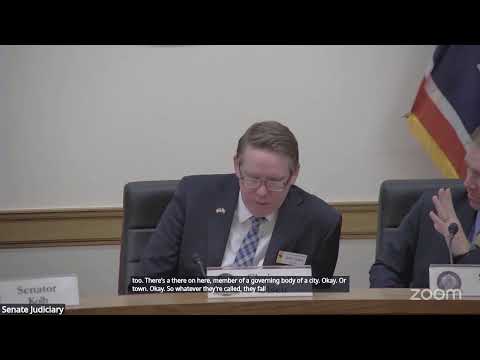
Committee action and amendments. After public testimony and discussion, committee members debated amendments to narrow and align the bill’s language. Senator Hicks moved the bill; Senator Kolb seconded. The committee adopted several amendments, including replacing the word "parent" with "party" in one fee-award clause to make the provision more reciprocal, and took a roll-call vote that recorded aye votes by Senators Crago, Crum, Hicks, Kolb and Chairman Olson. The committee advanced the bill as amended.
Why it matters. Supporters said HB157 would make enforcement of existing parental-rights statutes achievable in state court without forcing families into protracted federal litigation. Opponents cautioned that removing the notice requirement and leaving "infringement" undefined would create uncertainty for school districts and local governments and could encourage litigation rather than resolution through administrative channels.
Next steps. The committee advanced HB157 as amended; sponsors indicated they'll continue to work with stakeholders on scope and language before a possible floor consideration.