Get Full Government Meeting Transcripts, Videos, & Alerts Forever!
Get email alerts on the Financial Regulation topic
No spam. Unsubscribe anytime.
Senate committee rolls back House amendments to anti‑money‑laundering bill after bank and prosecutor concerns
Summary
After credit union and prosecutors' testimony that House amendments made the anti‑money‑laundering bill unworkably broad, the Senate Judiciary Committee voted to revert House Bill 43 to the House‑introduced version to allow more drafting time; the committee recorded three yea votes and two excused members.
The Senate Judiciary Committee moved on House Bill 43, an anti‑money‑laundering statute intended to align state law with federal enforcement tools. Senators and testifying stakeholders agreed the base bill seeks to give state prosecutors authority to address money‑laundering activities, but a large House amendment drew immediate concern in committee.
Senator Cole walked through amendments that broadened conflict‑of‑interest language and added a range of public servants and advisers into a definition of covered persons. The amendment also removed the "knew or reasonably should have known" standard in certain sections, replacing it with a stricter "knows" threshold—a change banking representatives warned could criminalize otherwise ordinary business activity.
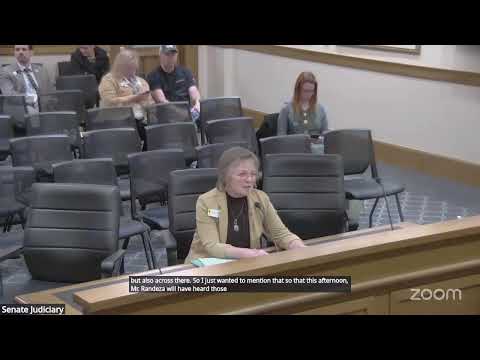
Bobby Frank, representing Wyoming’s credit unions, said his legal review showed the amended language could expose routine financial services—such as holding deposits for a local grocery store—to liability. "By this standard, a credit union could be charged with money laundering," Frank told the committee, illustrating why financial institutions sought clearer scienter language or an explicit carveout.
The Wyoming County and Prosecuting Attorneys Association also urged preserving a "reasonably should have known" standard to enable prosecutions built on circumstantial evidence, saying the stricter mens rea would make convictions near‑impossible in many cases.
Committee members debated options and Senator Cobb moved to return the bill to its original House‑introduced text so the sponsors and stakeholders could reconcile the competing concerns. The motion carried. The committee later took a roll call on advancing the bill (as adjusted in committee) and recorded three affirmative votes with two members excused.
Senators said they expect follow‑on drafting to include a targeted carveout for ordinary financial institutions and to restore or clarify the mens rea language so the statute does not sweep in benign, routine activity while still providing prosecutors with workable tools.
Action: Senator Cole moved the bill, Senator Craig seconded; a later motion (Senator Cobb) to revert to the introduced House version was adopted. Committee roll call on the bill recorded three 'yes' votes and two excused members.