Get Full Government Meeting Transcripts, Videos, & Alerts Forever!
Get email alerts on the Freedom Of Speech topic
No spam. Unsubscribe anytime.
Representative Singh introduces 'Wyoming Granite Act' to shield in‑state speech from foreign censorship
Summary
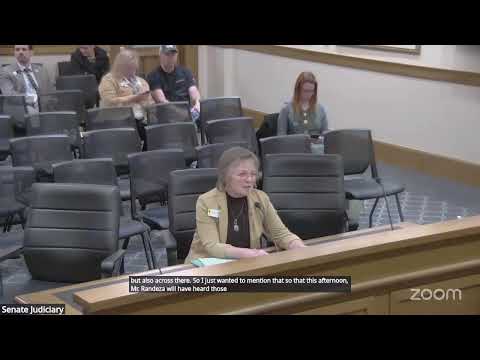
Representative Singh told the Senate Judiciary Committee House Bill 70 would create state causes of action and remedies to protect speech and data hosted in Wyoming from foreign censorship orders and extraterritorial penalties; senators pressed hard on jurisdiction, collection and whether the bill tells courts what to do.
Representative John Singh introduced House Bill 70, the Wyoming Granite Act, at the Senate Judiciary Committee hearing, saying the measure would let Wyoming protect expression hosted on servers in the state and give residents a state court venue to challenge foreign censorship or extraterritorial penalties.
Singh told senators the measure—whose name he said stands for "guaranteeing rights against novel international tyranny and extortion"—would recognize a state cause of action for people and Wyoming businesses whose speech or data hosting is targeted by foreign laws. He said the bill’s definitions cover Wyoming residents, local business entities and U.S. persons whose expressive conduct is hosted on servers physically located in the state.
“Granite stands for guaranteeing rights against novel international tyranny and extortion,” Representative Singh said, presenting the bill and walking members through legislative findings that cite recent actions by foreign authorities ordering content removals or imposing fines on American platforms.
Committee members focused much of their time on whether Wyoming courts could realistically acquire jurisdiction over foreign governments or entities and whether the bill’s language telling courts how to treat foreign censorship laws would improperly intrude on the judiciary. "How does the state of Wyoming gain jurisdiction over a foreign country?" one senator asked, pressing the sponsor to point to the statutory language establishing such jurisdiction.
The sponsor and witnesses pointed to federal hooks and existing doctrines as ways a Wyoming plaintiff might obtain relief. Colin Crossman, testifying in a personal capacity, said the federal Foreign Sovereign Immunities Act and precedent such as Calder v. Jones can provide jurisdictional hooks when the harmful conduct has effects in the United States. "If you send a threat into Wyoming," Crossman said, "the entire tort occurs in Wyoming," and that, he said, is one basis courts use to exercise jurisdiction.
But the committee repeatedly returned to two practical problems: collecting judgments against foreign sovereigns or entities that hold few U.S. assets, and the bill’s use of mandatory judicial language. Several members questioned a provision that would instruct a court to "presume" a foreign censorship law violates the U.S. First Amendment, warning that a statutory "shall presume" could be constitutionally or practically fraught.
Randall Luthie, the governor’s policy director, told the panel the administration supports the bill’s concept but said "we have a strong sense of uncertainty," urging caution on questions such as sovereign immunity, federal preemption and the attorney general’s authority to promulgate implementing rules.
Representative Singh and witnesses described amendments under consideration that would tighten federal conformity language and limit rulemaking, and the sponsor said fine‑tuning would continue. Public comment included support from a data‑hosting and free‑speech policy perspective and concern from members wary of overreaching civil penalties for state employees who might inadvertently touch foreign proceedings.
The committee did not vote to advance the Granite Act during the morning session and left the bill open for amendment and further legal review; staff and counsel signaled additional drafting to clarify jurisdictional hooks, collection mechanisms and the role of the attorney general.
The committee will continue consideration at a later meeting once sponsors supply drafting fixes and federal‑law cross‑checks.