Get Full Government Meeting Transcripts, Videos, & Alerts Forever!
Get email alerts on the Zoning Overlay Fix topic
No spam. Unsubscribe anytime.
Mayflower council adopts ordinance closing overlay zoning loophole and declares emergency
Summary
The Mayflower City Council unanimously adopted Ordinance 2025-08 to require commercial projects in the Heart of Mayflower overlay to undergo Planning Commission site-plan review, correct obsolete zoning references, and standardize residential setback and fence rules; an emergency clause made the ordinance effective immediately.
The Mayflower City Council on Tuesday approved Ordinance 2025-08, a measure staff said closes a technical loophole that let commercial projects in overlay zones avoid Planning Commission review. The council also adopted an emergency clause so the ordinance takes effect immediately.
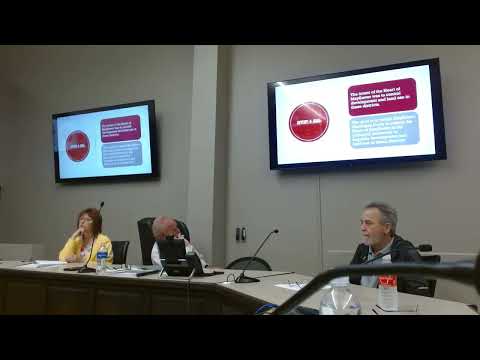
Chris, a city staff member who led the presentation, told the council the city's zoning has three overlapping layers'base zones (R1'R3), commercial districts (C1'C5) and overlay districts such as the Heart of Mayflower'and that conflicts between those layers had left developers and staff uncertain which rules applied. "We've got three layers of zoning within the city of Mayflower," Chris said, noting that the overlay'intended to govern design standards and commercial corridors'did not explicitly require site plans to be routed to the Planning Commission when the underlying base zone remained residential.
The ordinance amends chapter 14 of the municipal code to: delete obsolete references to non-existent R4/R5 zones; require that any commercial use within a Heart of Mayflower overlay district come before the Planning Commission for site-plan and conditional-use review regardless of the underlying base zoning; and clarify that Heart of Mayflower design standards prevail where they conflict with less specific city code provisions (with limited exceptions such as certain street and drainage references). The staff presentation said the change is intended to reflect the original intent of the Heart of Mayflower overlay and to remove ambiguity that could be exploited in permitting.
Councilors also discussed related technical fixes included in the ordinance: standardizing accessory-building setback requirements across residential and mobile-home districts, and changing the applicability of front-yard fence provisions so that any front-yard fence in a residential zone requires Planning Commission review to ensure safety (for example, tapering fence height to maintain sight lines). Chris described the ordinance as a targeted "band-aid" to address immediate, actionable gaps while the city continues work on a Unified Development Ordinance (UDO) that will comprehensively replace and streamline existing code.
At a roll-call vote the council recorded yes votes from Zack Jeffrey, Jack Paul, Kyle Marks, James Snider and Larry Hill; no dissenting votes were recorded. After adoption of the ordinance the council also voted to approve the emergency clause by the same unanimous roll call, allowing the ordinance to take effect immediately because staff said developers were making decisions based on the existing ambiguity.
The council directed staff to draft follow-up items for the next Planning Commission and council workshops, including a proposal to revisit a Heart of Mayflower provision that limits lot width to 40 feet in certain corridors; staff was asked to prepare an amendment to move those areas to a 60-foot standard where appropriate. Staff also flagged recent Arkansas legislation (referred to in the meeting as Acts 591, 313 and 595) that may limit municipal review authority in some circumstances and recommended the council review municipal procedures to remain compliant.
The council and staff said the ordinance and the UDO work aim to make zoning clearer and more predictable for property owners and developers while preserving safety and design standards. The meeting concluded with thanks to staff and a commitment to continued public outreach, including a town hall and additional workshops ahead of full UDO adoption.