Get Full Government Meeting Transcripts, Videos, & Alerts Forever!
Get email alerts on the Civil Service topic
No spam. Unsubscribe anytime.
Deputy employment manager David Lawrence presents Dayton civil service report, cites high no-show rates and calls for equipment and system upgrades
Summary
David Lawrence told the Dayton City Commission that the civil service office posted 189 jobs in 2025, received about 5,400 applications, placed roughly 2,500 candidates on eligible lists and is grappling with high no-show rates (36% overall and 50—60% for some safety-force exams); commissioners pressed for causes and follow-up plans.
Deputy Employment Manager David Lawrence told the Dayton City Commission on the agency's annual report that the civil service office posted 189 recruitments in 2025 and received about 5,400 total applications, of which roughly 3,900 were certified as meeting minimum qualifications and about 2,500 were placed on eligible lists.
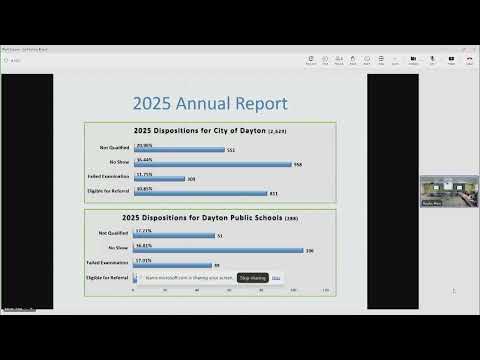
"We had 189 recruitments in 2025," Lawrence said, and described the pipeline from posting to certification and appointment, noting that competitive exams produced 811 candidates who passed to the eligible list out of roughly 2,000 who were eligible to take the exam.
Lawrence and the board highlighted a steep drop-off between applicants who apply and those who remain eligible or accept referral. "When you look at the city of Dayton, about 20% are not qualified, 36% no-show, 11% fail and about 30% are eligible for referral," Lawrence said. He added that no-show rates are especially acute for safety forces, where "we have probably close to 50—60% no-show rate" for police recruits.
The presentation described the office's processing workload: civil service staff completed nearly 1,600 background checks last year, about 323 medical exams and drug screens, and administered fitness testing and additional screening for police and fire candidates (polygraph and psychological evaluations for police; firefighter mile for fire candidates).
Commissioners pressed for explanations and remedies. "I'm curious if you guys have seen any trends or are there any routine patterns in what might lead a person to not meet the minimum qualifications for particular roles?" Commissioner Beckham asked. Lawrence replied that disqualifications typically reflect requirements in the job description (degrees, certifications or minimum years of experience) and that a substantial share of applicants apply broadly without meeting those qualifications.
Discussion of remedies focused on outreach, process improvements and technology. Lawrence described open testing (allowing candidates to test on multiple days), recruitment events at local high schools and colleges, and the city's ERP (enterprise resource planning) project as an opportunity to streamline administrative follow-up. "If we streamline administrative functions, we'll be able to reach out more personally to candidates," he said, arguing better follow-up could reduce no-shows and stale lists.
The commissioners also discussed temporary employees and conversion rates. Lawrence said some roles (for example, a public works helper) commonly use temporary hires who later convert to part-time or full-time roles, but retention and conversion rates vary by department.
Budget and a small capital request were also raised. Lawrence said roughly 70—75% of the civil service budget pays personnel; about $500,000 covers contracts and materials, including applicant tracking. Chair Tom Richie Sr. urged commissioners to consider a furniture and equipment investment for the civil service office, saying, "$75,000 is not a lot of money to put back into an organization that functions the long hours and the hard work that staff does over there."
Lawrence estimated it takes about six weeks to produce an eligible list when an up-to-date exam exists; non-competitive postings vary and may take longer. Commissioners noted that delays or stale eligible lists can contribute to attrition for some positions, while salary and work schedules are common reasons candidates decline an offer after referral.
On appeals and removals, Lawrence and board members described handling dozens of safety-force removals with chiefs and legal counsel. They said 72 removals were reviewed and that appeals to the board are carefully prepared; the board does not often overturn removals. Commissioners gave one example of an applicant with a disqualifying felony who nonetheless retains appeal rights.
The presentation closed with planned rule changes to address reinstatement and other procedural matters. Under current rules, employees who separate may request reinstatement within one year; the board said it will present proposed changes (including possible limits on reinstatement) to the commission.
The commission thanked the civil service board and staff and asked for follow-up data on retention, reasons for no-shows and temporary-to-permanent conversion rates. The office committed to providing additional drill-downs and to work with ERP implementation to improve outreach and tracking.