Get Full Government Meeting Transcripts, Videos, & Alerts Forever!
Get email alerts on the Sewer Rates topic
No spam. Unsubscribe anytime.
Livermore Falls Select Board adopts quarterly sewer billing and sets new rates to raise roughly $943,882
Summary
After a public hearing, the Livermore Falls Select Board voted to amend the sewer billing policy to quarterly billing based on actual usage and selected a rate scenario the board said would raise about $943,882 to cover sewer operations, debt service and contingencies. The board also announced major grant and loan awards tied to upcoming sewer work.
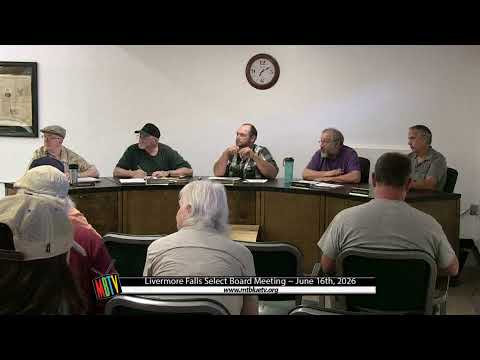
The Livermore Falls Select Board on June 16 voted to amend the town’s sewer billing policy to issue quarterly bills based on actual water usage and approved a rate scenario the board said is intended to raise approximately $943,882 for sewer operations and debt service.
The change follows a public hearing in which town staff presented multiple rate scenarios that trade off a higher minimum charge against a lower per-cubic-foot charge. Tammy, the town sewer clerk, explained the town previously billed using a 3,200-cubic-foot baseline and annual billing with two payments, and that the board had asked staff for additional options after two workshops. "There was 72,000 cubic feet that we are not collecting money for that's been used in the system," Tammy said, describing an unbilled-usage discrepancy staff found while analyzing actual four-quarter usage.
Why it matters: Board members said the sewer enterprise is not fully self-supporting and needs new revenue to cover operating costs and debt. Tammy told the board the sewer budget totals more than $1.3 million but interlocal reimbursements reduce the amount that must be raised through rates to about $943,882. The board emphasized the goal of keeping the system self-supporting so general-fund taxpayers do not subsidize sewer operations.
Staff and board members highlighted trade-offs behind each scenario: higher minimum charges spread fixed costs across more accounts but increase costs for low-usage residential customers; lower minimums shift more burden to large commercial users via a higher per-unit rate. Tammy recommended a scenario described in the materials as the fourth option up from the bottom, which the board selected as its starting point. Under examples shown at the hearing that scenario would produce higher annual bills for some low users (a cited example rose from $345 to roughly $840 per year under one model) but would also reduce the need for a near-term additional increase, board members said.
Financial relief and project funding: Town staff (Carrie) announced the project tied to Route 17 upgrades received a $2.351 million State Revolving Fund (SRF) award with $1 million principal forgiveness, leaving $1.351 million in loanable principal, and separately reported the town received a $1 million Northern Borders grant. "That means the sewer users are paying back $351,000 for the $2.351 million project," Carrie told the meeting, drawing applause from attendees.
Policy and implementation: The board first voted to amend the sewer billing policy to quarterly billing and to base bills on actual usage (payments due net 30). Later the board moved to accept the recommended rate scenario; after discussion the motion passed with one member opposed. The board also said staff will continue customer outreach, allow prepayments, and handle leak or one-off usage abatements on a case-by-case basis under the billing policy.
What comes next: Board members said the change will require administrative updates and customer notifications; the board also noted the Route 17 construction schedule remains subject to permitting and bidding timelines, and loan payments typically begin once the loan is closed. Staff said bids for the project were likely to go out in the fall but permitting (including railroad permitting) has caused delays.
Quotes: "Quarterly billing would be more fair and equitable to the customers," Tammy said during the hearing, describing that quarterly invoices would better reflect actual usage for many customers. "We did get word last week that we were approved for the $2.351 million SRF loan," Carrie said, noting the principal forgiveness and the separate Northern Borders grant.
The Select Board closed the public hearing and adopted the policy change and rates during the June 16 meeting. The board directed staff to implement the new billing schedule and to continue public outreach so customers understand how the change affects their bills.