Get email alerts on the Education Funding topic
No spam. Unsubscribe anytime.
Local school officials urge support for Permanent School Fund ballot amendment; explain how formula would change
Summary
Local school administrators briefed the Waseca County Board on a proposed constitutional amendment to change Minnesota’s Permanent School Fund distribution formula, saying a three‑year averaging method and a 4.5% payout could stabilize and increase annual payments to districts without raising taxes.
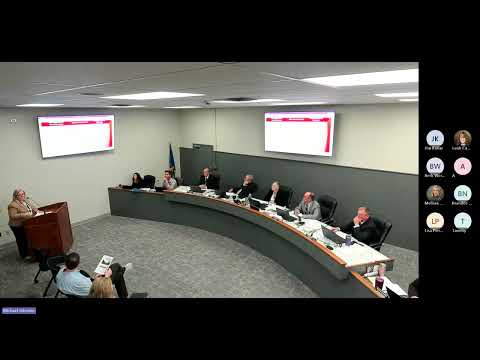
Wendy Dyker, a local school business manager, told the Waseca County Board that a constitutional amendment on the November ballot would change how earnings from Minnesota’s Permanent School Fund are distributed to public school districts. The fund, she said, is currently valued at about $2.3 billion and is managed by the Department of Natural Resources (land parcels) and the State Board of Investment, which invests the trust and distributes proceeds to education.
Dyker said a 2024 legislative task force recommended removing some distribution specifics from the constitution and adopting a more flexible rule based on a multi‑year average. “The recommendation is to use a three‑year average of the trust’s value and distribute 4.5% of that value,” Dyker said, adding that the change is designed to smooth year‑to‑year volatility in payouts. She and other presenters said the change would not raise individual income or property taxes and that the ballot question will require a majority of those voting on it to pass.
To illustrate local effects, Dyker and district representatives provided example calculations for the most recent year: under the proposed formula, the district payments in the example year would have been roughly 40% higher than the distribution actually made. The presenters noted that such an increase could help districts facing declining enrollment by softening per‑pupil revenue losses.
Board members asked for clarifications about the fund’s size and the calculation mechanics. Dyker said the trust’s present balance is about $2.3 billion and the state has in recent years distributed roughly $58 million to districts; under the proposed approach those annual distributions would be more predictable. She pointed commissioners and constituents to the full task force report (86 pages) and to materials from the Minnesota School Boards Association and the Department of Natural Resources for additional technical detail.
No action was taken by the board; the presentation served to inform commissioners and ask for help spreading information about the ballot question to residents.
The county will not adopt policy for the measure; the decision rests with Minnesota voters in November.
AI generated
The text on this page is AI generated. Summaries, highlights, analysis, and video transcripts are all produced from the original source material.
AI can make mistakes, so if you spot one, and we will fix it for everyone.
Note: the source content is unaltered by us. Any content source we link to, be it a video, an audio recording, or a document, is presented exactly as its publisher released it. That publisher is usually a government body, sometimes an individual official or another organisation.