Get Full Government Meeting Transcripts, Videos, & Alerts Forever!
Get email alerts on the Zoning Udc topic
No spam. Unsubscribe anytime.
Troy planners review draft Unified Development Code; debate waiver authority, fuel‑station rules and ADUs
Summary
At a June 18, 2026 work session, the Troy Planning Commission heard consultants present a draft Unified Development Code to consolidate zoning, subdivision and sign rules. Commissioners sought clearer limits on administrator waivers, data‑center standards and sign/measurement rules; staff said redline drafts will be posted online for review.
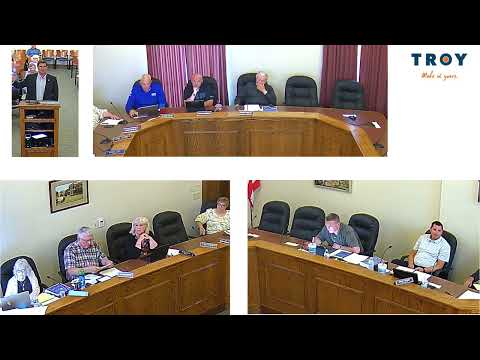
The Troy Planning Commission on June 18, 2026 heard a detailed presentation from consultants at American StructurePoint on a proposed Unified Development Code (UDC) that consolidates the city’s zoning, subdivision and sign regulations.
Tim, a planning staff member, opened the work session by calling the update a multi‑meeting project and stressing that “we are not asking for anything at this point in time,” describing tonight as an opportunity to review structure and solicit feedback. Matt Oor of American StructurePoint framed the UDC as a user‑friendly consolidation that ties the city’s 2005 comprehensive plan into enforceable zoning standards.
Consultants said the UDC condenses roughly 320 legacy use types into about 86 defined categories, standardizes definitions, and replaces text‑heavy sections with tables and graphics to make staff responses to applicants faster. “We have merged that into like 86 new use types and every one of those has a definition at the end of the code,” David Barrett of American StructurePoint told the commission.
Key policy elements highlighted in the draft include: a measurable “close‑knit factor” requiring developers to provide offsets such as trails, parkland or street frontage connections; new accessory dwelling unit (ADU) rules that permit ADUs while requiring owner occupancy of the primary unit; reduced parking tables and queuing ("stacking") standards for drive‑throughs; and a citywide prohibition on certain primary uses while allowing some of those uses as accessory to larger developments (for example, automobile fuel dispensing stations would be prohibited as a primary use but permitted as an accessory to large‑scale retail).
The consultants and staff also flagged specific proposed prohibitions and changes: tattoo parlors were moved out of the limited M‑2 industrial allowance and into the prohibited list citywide under the draft; mobile and manufactured homes remain on the prohibited list while modular homes would be permitted; and certain new use‑specific standards (for example, decommissioning plans for solar systems) appear in the draft while consultants said standards for newer uses such as data centers will require additional research.
Commissioners pressed staff on several points. Multiple members questioned whether the city manager — designated in the draft as the "development code administrator" — should be authorized to grant waivers for the close‑knit offsets. Commissioners argued that at least some waiver decisions should come before the Planning Commission for transparency. Tim said the administration could change that language and welcomed discussion of whether the waiver process should be elevated to a public body.
On gas stations, consultants said the draft aims to curb an overconcentration by permitting fueling operations only as accessories to large‑scale retail (suggested threshold: 50,000 square feet) while prohibiting fueling stations as standalone primary uses across the city. Commissioners asked for clarity on the draft’s text distinguishing prohibitions from table‑based allowances.
Several commissioners asked for more explicit standards on emerging uses. A commissioner noted the draft lists distance/buffer standards for data centers (for example, setbacks from hospitals and parks) but lacks the decommissioning/exit strategy language found in other use chapters; consultants agreed to research best practices and consider additional provisions.
Public access and document management were also raised. Resident Steve Hendrickson asked how members of the public and elected officials will find “the most up‑to‑date” draft among iterative redline revisions; staff replied that supplemental drafts and redline updates will be posted on the city’s planning page so there is a single authoritative copy.
No formal votes or recommendations were taken at the work session. Staff and consultants said they will circulate redline drafts that incorporate commissioners’ policy questions, allow roughly a month for written comments, and then return for additional work sessions and a future public hearing before the Planning Commission and subsequent City Council review. The meeting adjourned after commissioners moved and seconded an adjournment.