Get Full Government Meeting Transcripts, Videos, & Alerts Forever!
Get email alerts on the Ambulance Funding topic
No spam. Unsubscribe anytime.
Lennox and regional officials weigh funding options to sustain ambulance coverage
Summary
Municipal leaders, county commissioners and consultants reviewed EMS data showing strong county coverage but rising costs; consultants proposed three funding scenarios (keep Lennox-only, build a central station, or staff two bases) and urged budget decisions before September hearings.
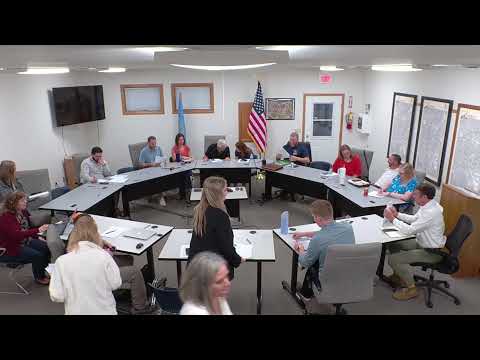
Lennox — Municipal leaders, county commissioners and township officials met to review county EMS data and consider funding options to preserve ambulance service in Lennox and surrounding jurisdictions.
Consultant Justin Paper of Paper Analytics presented recent call data and predictive modeling showing 1,712 EMS calls in Lincoln County over the last 12 months and a modest projected rise to about 1,760 calls next year. Paper said the countywide average dispatch-to-door response time is just under 10 minutes 30 seconds, and that the city of Lennox’s response time within city limits is 6 minutes 42 seconds — among the fastest services in the county. "We might see a 10 or 15% increase next month in volume," Paper said, describing the model that counties and services can use to anticipate demand.
Sharon Johnson of Project Solutions described a Department of Health rural services designation grant the consultants hold (contract through November 2026) and laid out three funding scenarios for sustaining 24/7 ALS coverage: continuing the current Lennox jurisdiction, expanding the ambulance jurisdiction and building a station between Lennox and Tea, or operating two staffed bases in Lennox and Tea. For the scenarios the consultants modeled, Johnson said the annual funding gap would be roughly $400,000 for Lennox‑only, about $475,000 for a central station that serves Lennox and Tea, and roughly $850,000 for two staffed bases (the latter figure accounts primarily for staffing and excludes significant capital costs such as new buildings).
Johnson summarized statutory tools available in South Dakota, noting ambulance districts governed by an elected board and constrained levy authority under state law (referenced in the presentation as codified law 34‑11A). She described two common levy approaches — a uniform mill levy on taxable valuations or a special assessment that can exempt certain classes like bare agricultural land — and cited other counties’ experience where a special assessment averaged about $250 per property to cover a multimillion-dollar shortfall.
Officials pressed on fairness and governance. Township representatives asked whether interstate crashes are assigned to the township where the incident occurs; Paper said he geolocates calls to the latitude/longitude and assigns them to the correct township for revenue/share calculations. Several townships favored excluding bare land from assessments and weighting contributions toward owner‑occupied or commercial parcels. A Tea representative said the city prefers to fund its share from general-fund dollars rather than by imposing a new property-tax levy on residents: "We're not going to ask our citizens to put more property tax on themselves through a levy or a special assessment," the Tea representative said.
County commissioners indicated the county is willing to participate but described fiscal limits. One commissioner noted the county is managing a significant budget gap and could not commit an unlimited amount; the group discussed proposing a specific county contribution (examples in the consultants’ materials ranged from a modest line‑item appropriation to larger sums contingent on other jurisdictions’ participation). The consultants recommended each jurisdiction provide parcel-level valuation and call-volume confirmations so final per-jurisdiction shares can be calculated.
Next steps agreed to at the meeting included follow-up visits to jurisdictions to present detailed spreadsheets, asking county assessor/auditor offices to produce jurisdictional parcel/value breakdowns, and attempting to firm a participation commitment in time for upcoming budget cycles (the consultants and several officials noted a September public hearing timeline for budget adoption). The meeting ended without a formal decision to create an ambulance district; officials moved to continue the work and return with numbers that could be included in the county and municipal budgets.
Because the consultants flagged multiple workable approaches, officials said they will pursue a shared‑funding model by call volume or population if the taxing‑district route proves politically difficult. Sharon Johnson said the consultants will continue to help jurisdictions refine scenarios and return with precise per‑township figures once assessors provide parcel splits.
The meeting closed with a motion to adjourn and a commitment to schedule follow‑up meetings with townships and city councils to finalize participation and budget requests.