Get Full Government Meeting Transcripts, Videos, & Alerts Forever!
Get email alerts on the Lead Service Lines topic
No spam. Unsubscribe anytime.
Cheyenne staff ask SLIB for up to $20 million to investigate and begin replacing lead service lines
Summary
Cheyenne BOPU asked the finance committee to recommend a resolution to apply to the Wyoming State Loan and Investment Board for up to $20 million from the Drinking Water State Revolving Fund to inventory and begin replacing lead service lines; staff said the state program could include up to 25% principal forgiveness and initial funds would support investigatory potholing and priority replacements for high‑risk customers.
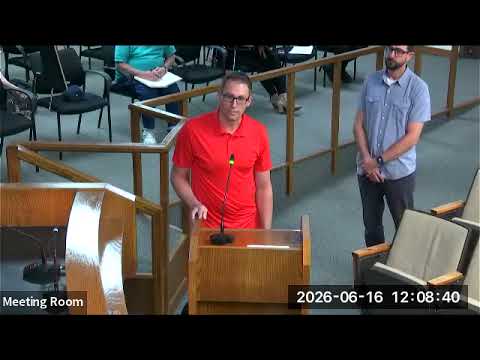
Cheyenne Board of Public Utilities staff told the city finance committee on June 16 that the city will apply to the Wyoming State Loan and Investment Board for up to $20 million from the Drinking Water State Revolving Fund to investigate and begin replacing lead service lines.
“On the worst level, we foresee the potential of upwards around $und00 million to complete this overall project,” said Bryce Biller of the Cheyenne BOPU engineering department, describing the program as larger than the requested amount. He said the state funding opportunity includes the potential for “25% principal forgiveness,” a subsidy that would reduce the loan burden on ratepayers.
Biller said the initial $20 million request is intended to fund the investigatory phase: hydro‑excavation and potholing at private residences to identify service‑line materials; creation of a baseline inventory for EPA reporting; and limited replacement of high‑risk customer lines such as medical facilities, childcare providers and schools. Jeff Foreman, BOPU GIS supervisor, described a project team led by GIS for cataloguing lines, a full‑time construction inspector to perform QA/QC on field work, and plans to document findings with photos for EPA submission.
Committee members asked about administrative costs, project staffing, and timing. Biller described administrative costs as permitting, right‑of‑way work and traffic control; he said the utility has hired one full‑time construction inspector and will rely largely on existing staff and contracted hydro‑excavation to limit new permanent hires. On schedule, staff said the BOPU expects to begin sampling and inventory work and to submit monthly reimbursement requests to SLIB; the earliest SLIB meeting likely to consider the application was cited as September (staff said their recollection pointed to a September meeting).
Several members asked whether homeowners would bear replacement costs. Staff explained Cheyenne is a “split utility” with ownership split at the curb stop: the BOPU generally pays to replace the utility’s half while homeowners remain responsible for their private portion. Staff said the utility will provide mitigation (filters and outreach) and prioritize full replacements where the customer is high‑risk or requests prompt action. Foreman added that under current local ordinances the utility does not have authorization to work past the curb stop, and that a national lawsuit (American Waterworks Association v. federal government) is relevant to how broadly utilities may use public funds to replace private portions.
The committee voted to recommend adoption of the resolution and forward it to the governing body for final action.
What’s next: The committee recommended the resolution for adoption by the full governing body; staff will prepare the SLIB application materials and pursue monthly reimbursement procedures if approved.