Get Full Government Meeting Transcripts, Videos, & Alerts Forever!
Get email alerts on the Waterway Dredging topic
No spam. Unsubscribe anytime.
Port Richey councilors direct staff to pursue full dredging permit after consultant review
Summary
After a June 18 workshop, Port Richey City Council members supported pursuing permit applications to authorize dredging of city waterways as scoped by consultant Stantech, citing a desire to preserve future work options despite potential seagrass mitigation and costs estimated at $9.9M–$14.66M.
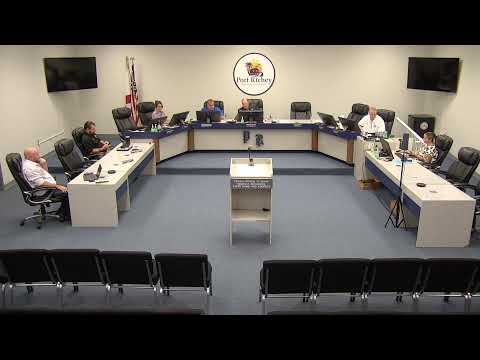
At a June 18, 2026 Port Richey City Council workshop, council members directed staff to proceed with permit applications for a citywide dredging project after Stantech consultant Matthew Star presented hydrographic, geotechnical and submerged‑resource survey results and cost estimates.
The presentation summarized 400 pages of survey work and recommended a dredge template to minus 5 feet mean low water across the selected canals. Star said the team measured roughly 60,000 cubic yards of material in the project area — about 55,000 cubic yards of sediment and roughly 5,000 cubic yards of rock — and that most thicker deposits were in the three‑to‑four‑foot range. "Between the rock and sediment, there's about 60,000 yards of material altogether in the project area that we'd have to remove to get everything down to minus 5 ft mean low water," Star said.
Why it matters: the amount and type of material affect construction methods, disposal requirements and costs. Stantech gave conceptual cost ranges of $135–$210 per cubic yard for sediment and about $500–$600 per cubic yard for rock, producing a total dredging cost estimate of roughly $9.9 million on the low side to about $14.66 million on the high side.
The geotechnical testing — 37 samples collected for permitting — found arsenic levels in about half the samples above residential screening levels but below commercial thresholds. Star said arsenic in the area is commonly associated with Florida limestone and with pressure‑treated pilings; he said post‑dredge dilution and retesting would be used before off‑site disposal and that the sampling suite is sufficient for regulatory submittals.
The submerged‑resources survey (September 2025) found patchy and some dense seagrass in northern project areas and a small clump of oysters near channel 19. Star told council that because seagrass exists in portions of the project, mitigation requirements are uncertain until agency reviews. "If US Fish and Wildlife Service when they do their review of the Army Corps permit . . . require mitigation then the Army Corps is not going to request it. That will not be known until permit apps are submitted though," he said.
Permitting pathway and timeline: Stantech reported pre‑application meetings with the Florida Department of Environmental Protection (DEP) and the U.S. Army Corps of Engineers. DEP said the city must demonstrate waterways were man‑made before April 1970 to qualify some channels as maintenance dredging; otherwise DEP would treat them as new dredging, potentially triggering additional mitigation. The seagrass survey the city currently has is valid for one year; Stantech advised submitting an application by Sept. 22, 2026 to rely on the existing survey. Star estimated DEP review timelines of 12–18 months if mitigation is required and an Army Corps timeline of 24–36 months in current staffing conditions.
Council discussion and direction: Council members and staff debated whether to limit the permit area to avoid seagrass impacts or to include all surveyed canals now to avoid repeating costly sampling later. Several members argued that capturing full extents on the permit would prevent redoing hydrographic and seagrass surveys later and would allow phased construction and private owners to use permits for future private dredging. Councilman Robert Hubard pressed for specific additional areas — including state waters near Whiskey Joe's, Waterfront Park and portions of Harbor Point — to be reviewed for possible expansion; staff said additional seagrass and sediment sampling would be required if those areas fall outside the current survey footprint.
The council gave direction to staff to prepare the proposal to move forward with permitting the project as currently scoped and to bring that proposal to the July council meeting; staff indicated a purchase order (PO) would be needed and discussed options to push initial invoicing into the new fiscal year. Vice Mayor Chris Mayer said he was "grateful and thankful that we're at this point" as the city moves toward cleaning the waterways.
Mitigation, construction and community engagement: Star explained mitigation could be required for seagrass and described options for oysters, including transplanting or relocation. He also noted construction differences where rock removal is needed (rotary cutter drum or hydraulic hammer). The consultant and council discussed the possibility of involving local nonprofits and volunteers in mitigation activities such as replanting seagrass or installing oyster slats to reduce net cost and provide public outreach.
Next steps and outstanding items: staff and Stantech will: (1) prepare the formal proposal and scope for council consideration in July, (2) collect any additional targeted survey data if council identifies extra areas to include, and (3) aim to submit permit applications before Sept. 22, 2026 so the current seagrass survey remains valid. Permit fees to agencies (DEP, Army Corps) were listed separately and are to be paid by the city; the largest unknown cost driver remains agency‑required mitigation for seagrass impacts.
Ending: The workshop concluded with consensus direction to pursue the permitting path as scoped and with the understanding that final funding, design and mitigation requirements will be refined during permit review and at subsequent council action.