Get Full Government Meeting Transcripts, Videos, & Alerts Forever!
Get email alerts on the Budget topic
No spam. Unsubscribe anytime.
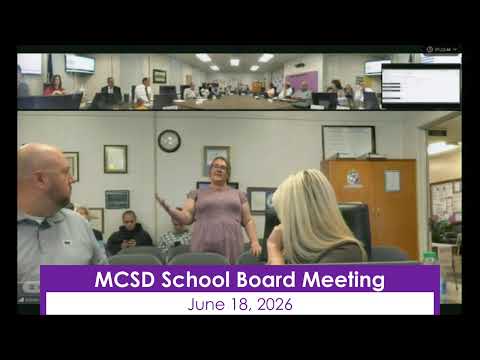
Mifflin County SD board hears budget shortfall and tax scenarios ahead of special vote
Summary
The Mifflin County School District board reviewed a 2026–27 budget presentation that showed a multimillion-dollar deficit and several local tax scenarios; administrators warned state 'adequacy' funding materially affects long-term solvency and a special budget vote is scheduled next week.
The Mifflin County School District board on June 18 reviewed budget projections showing a multi‑million dollar shortfall for 2026–27 and discussed local tax‑increase options ahead of a special budget vote scheduled for next Thursday at 6:30 p.m.
The business manager told the board the district began budget modeling this cycle with a roughly $6.1 million deficit, and that salary and benefits and a large health‑insurance increase were the primary drivers. "We started with a deficit of 6.1 million," the presenter said, and later noted a health‑insurance increase that was reduced after a $318,000 credit. The presenter reported revenues of "9957827" and expenses of "105673887" in the slides shown to the board; the transcript record of the preliminary deficit figure contains a verbal correction and the exact formatted tally was not read back.
Why it matters: the board is required to pass a final budget by the end of June; administrators said continued dependence on state adequacy payments and choices about local taxation will determine whether the district's fund balance stays positive over the next decade. The presentation showed that a one‑time local tax increase would not restore the district's 2030 fund balance to zero in the models, while recurring increases or continued state adequacy funding materially improve the outlook.
Board members pressed for specifics about the adequacy payments and debt service related to past capital projects. The presenter described three local tax scenarios that will be on the special meeting agenda: a half‑mill, a 1‑mill and a 1.657‑mill (full Act 1 index) increase, with rough incremental local revenue estimates presented in the slides (about $489,000, $840,000 and roughly $1.4 million respectively). The slides also showed that instruction makes up the largest share of spending (the presenter said roughly 60% of the budget) and that salaries and benefits account for about 64% of expenses.
On state funding, the presenter noted the governor's adequacy proposal and modeled how staged adequacy payments — described verbally as roughly 2.5 percentage‑point increments added to the district's base — would reduce the district's need for local revenue increases. "That's how much a difference adequacy is," a board member said after reviewing the charts.
What the board will do next: the superintendent announced a special voting meeting next Thursday to consider the budget and any tax proposals. The board requested the presenter share the slide deck in advance. No formal roll‑call votes on the budget or tax options were recorded in the public transcript provided.
Notes on figures and attribution: the numbers above are taken from the board presentation and the public remarks recorded in the transcript; where verbal corrections or unclear enunciation occurred (for example when the presenter restated the preliminary deficit), the article cites the transcript verbatim and flags uncertain formatting. The business manager who led the budget presentation is listed in the board record as Mrs. Kep; the superintendent who announced the special meeting is Vance Barner.