Get Full Government Meeting Transcripts, Videos, & Alerts Forever!
Get email alerts on the Remote Participation topic
No spam. Unsubscribe anytime.
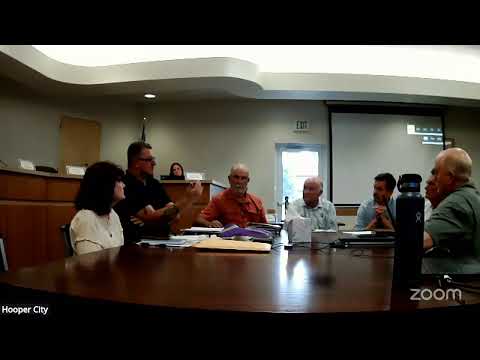
Hooper council debates tightening rules for remote (Zoom) participation while weighing access and quorum concerns
Summary
Council members debated whether to codify or revise the rule allowing virtual participation, balancing openness and access for candidates/officials who cannot be physically present against transparency, quorum integrity and closed-session fidelity; staff will draft specific language for a future agenda.
Council members spent a major portion of the work session reviewing the city’s Zoom and remote-participation rule, originally adopted during the COVID emergency, and weighing whether to convert that rule into a formal ordinance or to revise the existing rule to add visibility and behavior standards.
Darren (staff) explained that state law permits virtual public meetings if a jurisdiction adopts a rule, resolution or ordinance and that Hooper initially adopted the policy as a rule in 2020; the rule remains valid but can be revised and codified into the municipal code if the council prefers. He said the rule currently allows virtual participation when conditions in the rule are met and that the state code gives local options on restrictions.
A council member who regularly participates by Zoom argued strongly for keeping remote attendance as an option, saying it allows “qualified citizens to continue to serve the community while balancing a professional and family obligation.” That speaker urged reasonable technical and conduct standards—visible face, professional backdrop, no driving while participating, and advance notice to the presiding officer—rather than a blanket prohibition.
Other council members raised concerns about quorum clarity, whether a Zoom participant should count toward a quorum when a physical quorum is present in the council chamber, and whether remote participants should be permitted in closed-door (executive) sessions. Several members favored prohibiting remote attendance for closed sessions and adopting practical safeguards for open meetings (a moderator to manage hand raises and to mute participants, default muting until recognition, and pre-verification for remote voting eligibility).
The council also discussed implementation issues: technology training for staff, adding a requirement that remote attendees must be visible on camera and not in a public place while participating, and creating an acceptance process so remote attendees explicitly sign in as participants before they can vote. Council members asked staff to return proposed language to a future agenda and volunteered to help test equipment and training before public deadlines in August.
Ending: Staff (Darren, Morgan and others) will draft recommended changes—options include codifying the rule into ordinance form, imposing minimum visibility/engagement standards, requiring advance notice for remote participation, and barring remote attendance for closed sessions—and return the draft for council consideration and public hearing.