Get Full Government Meeting Transcripts, Videos, & Alerts Forever!
Get email alerts on the Xeriscaping topic
No spam. Unsubscribe anytime.
Hooper council discusses adopting state-backed xeriscaping rebate program to give residents a water-wise option
Summary
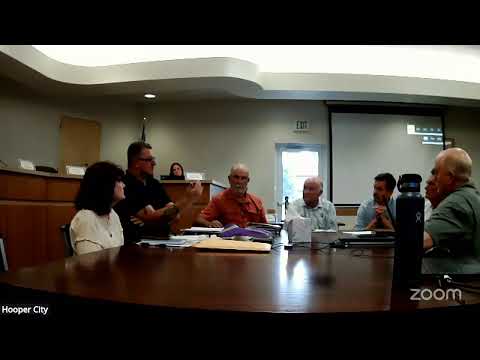
Council members heard a presentation on a state-backed xeriscaping (water-wise landscaping) incentive that would require a local ordinance for the city to participate; staff and council asked for clarifications about eligible materials, whether incentives stack, and rules that would apply to new development.
A presenter for the program described a state-supported xeriscaping incentive and asked the Hooper City Council to consider adopting a local ordinance so residents could qualify for payments tied to removing turf and installing drought-tolerant landscaping.
Doug, who addressed the council at the work session, said the program had saved roughly 100 million gallons statewide last year and is administered locally by Weber Basin. He described the financial mechanics as Weber Basin offering up to $2.50 per square foot and the state contributing up to $2 per square foot; whether the two amounts are strictly additive or combined was described by staff as unclear and will be confirmed with Weber Basin. Doug gave an example that converting 5,000 square feet of lawn could reach a total incentive in the low tens of thousands of dollars depending on interpretation of the offers and program caps.
The presenter also outlined the local ordinance elements that would be required for the city to participate: incentives for existing homeowners who voluntarily convert landscaping, and design standards for new development that would restrict grass in narrow park strips (anything 8 feet wide or smaller), prohibit grass in certain park-strip zones, and limit front-yard grass to 50% under the suggested draft language. Staff noted they still need to confirm whether the 50% calculation includes driveways and park strips and whether redevelopment triggers the same 50% requirement.
Council members questioned the program’s overall statewide impact: one member noted that 100 million gallons, while meaningful locally, is small compared with statewide diversions and Great Salt Lake evaporation figures, and characterized the measure as incremental. The presenter and several council members framed the program as an optional, near-term choice for residents that would also position Hooper to comply should the state later adopt stricter requirements.
Council members also asked detailed eligibility questions. The presenter and staff said Weber Basin’s inspectors perform a virtual site review (applicants show their property by video), projects must be completed up front (payments come in two to four months after final inspection), and there is a program cap that council was told is $50,000. The program disallows bare rock as the primary ground cover in many cases but permits mulch, ground cover plants, shrubs and drought-tolerant trees; staff will ask Weber Basin for a definitive plant list and rules. One council member cautioned that large shade trees could increase local evaporation, and that plant selection should be guided by state-approved drought-tolerant lists.
No ordinance was adopted at the work session. Staff were asked to clarify outstanding points—particularly whether incentive amounts are additive (Weber Basin + state) or exclusive, the precise plant list, and how the 50% front-yard measure is calculated—and return to the council with a draft for public hearing and formal consideration.
Ending: Staff will confirm program details with Weber Basin and prepare a draft ordinance and implementation guidance for a future agenda.