Get Full Government Meeting Transcripts, Videos, & Alerts Forever!
Get email alerts on the Workforce Development topic
No spam. Unsubscribe anytime.
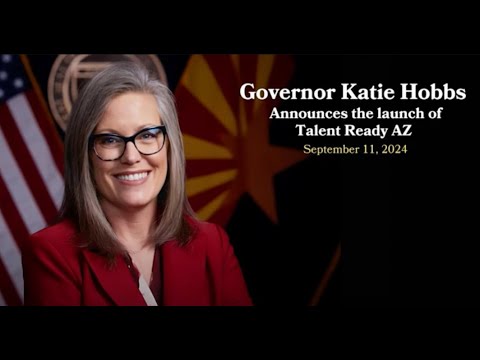
Governor Hobbs launches Talent Ready Arizona, signs order to create statewide Workforce Cabinet
Summary
Governor Hobbs announced the Talent Ready Arizona initiative and signed an executive order establishing a Workforce Cabinet to coordinate state agencies and industry, require portions of federal grants be used for workforce development, and centralize workforce data at the Office of Economic Opportunity.
Governor Hobbs announced the Talent Ready Arizona initiative and signed an executive order creating a statewide Workforce Cabinet intended to align state agencies, industry and education to build pipelines for ‘‘good paying, high-demand jobs.’'
The initiative, Gov. Hobbs said, will form industry- and population-focused working groups and direct participating state agencies to share workforce program data with the Office of Economic Opportunity (OEO). "Connecting Arizonans to good paying, high demand jobs is essential to a strong future for all of us," the governor said, adding the cabinet will focus on sectors that include advanced manufacturing, construction trades, broadband, health care, aerospace and defense, clean energy and early childhood education and child care.
The plan contains several components: the creation of a Workforce Cabinet with agency and industry members charged with implementing and aligning programs; a requirement that agencies allocate a portion of incoming federal funds for workforce development where allowable; and an OEO-led inventory and data hub to track programs and outcomes across state government.
Carlos, director of the Office of Economic Opportunity, said OEO will be the cabinet's data hub and cited recent labor-market figures as context: "In June OEO reported 94,000 job openings," and he said Arizona's July unemployment rate remained below the national rate at 4.3 percent. He described the OEO role as taking an inventory of existing workforce programs to improve tracking and coordination.
Angie Rogers Dees, director of the Department of Economic Security, outlined how Arizona @Work and related programs will support the cabinet. She said DESE helped nearly 30,000 Arizonans become employees in state fiscal year 2024, supported about 400 employers and placed roughly 2,300 people in work-experience and training programs.
The executive director of the Arizona Commerce Authority described the state's prior workforce partnerships — including the Arizona Advanced Technology Network and Future 48 accelerators — as groundwork the cabinet will scale. Alex Corwith, senior vice president and chief human resources officer at TMC Health, said healthcare added roughly 24,000 positions year-over-year (2023–24) and projected about 76,000 additional positions by 2030; he highlighted a paid RN preceptor program with 300 trained preceptors and 140 newly hired RNs at TMC in Southern Arizona in 2024.
Apprentice Gabriela Medina of Intel, who said she was one of 10 women selected from about 300 applicants for her program, described how the apprenticeship and partner supports helped her move from being a stay-at-home parent back into a technical career. "I am one of 10 incredible women who were selected and we continue to impress and succeed," she said.
The event concluded with the governor signing the executive order to establish Talent Ready Arizona and the Workforce Cabinet; organizers said participating agencies will be required to share data with OEO and to use available federal funding to support workforce development where permitted. No implementation timeline or budget breakdown was specified at the announcement.
Next steps listed by speakers included formalizing cabinet membership, establishing working groups for the named sectors, taking an inventory of existing programs and directing agencies to share workforce data with OEO.