Get Full Government Meeting Transcripts, Videos, & Alerts Forever!
Get email alerts on the Local Infrastructure topic
No spam. Unsubscribe anytime.
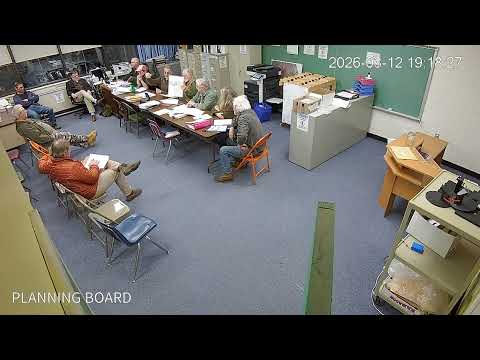
Baldwin planning board reviews 1-MW Emerald Trail solar proposal, defers action pending title and access documents
Summary
The Baldwin Planning Board heard a presentation from Glenn Walker of Aadia Energy for Emerald Trail LLC on a proposed 1 MW AC fixed-tilt solar project on a 59-acre parcel. Board members raised concerns about truck access on Deacon Road, subdivision/title irregularities, visibility from Route 113, wetland setbacks and decommissioning guarantees; the board declined to accept the application tonight and requested additional documentation and a sitewalk/public hearing.
Glenn Walker, the applicant representative for Aadia Energy speaking for Emerald Trail of Maine LLC, presented a proposal for a 1 megawatt AC fixed-tilt solar array sited on a 59-acre parcel in Baldwin. Walker said roughly 15 acres would be cleared for the project, the fenced array would be about 9 acres, the panels would be fixed and face south, and the site would be accessed from Deacon Road with the electrical interconnection to three‑phase CMP lines on Route 113.
The board pressed the applicant on practical and legal safeguards. A planning board member who lives on Deacon Road urged careful construction logistics to avoid hazardous congestion, saying the road is one-lane in places and that an 18-wheeler could block resident access. Walker said typical construction for a project this size would require one or two truckloads for racking and panels and a crane to set the transformer, and that the team would prepare a traffic plan and consider breaking deliveries into smaller trucks if necessary.
Town officials and members focused on two interrelated issues they said must be resolved before the board moves forward: documentation of ownership/subdivision and confirmation of utility interconnection. Several members noted the parcel had previously been permitted for a larger 5 MW project that did not proceed after a rules change; board members asked that proof of CMP interconnection approval be provided in the submittal package and that the applicant include deed or title documentation for the landowner identified in the application (recorded as Jamie McDonald in most places in the record). Walker agreed to provide CMP-related paperwork and confirmed wetland delineation had been field-flagged by David Moyes and included in the stormwater/permit-by-rule submission.
On environmental and financial protections, Walker said the applicant had filed a state decommissioning plan and understood the state may require a decommissioning bond; he said the state bond process updates values periodically and the town can be named on a bond so it would have recourse if the operator failed to decommission. Board members asked for proof that any state-level performance guarantees or bonds would also afford protection to the town and requested evidence of the applicant’s general liability insurance and that the performance guarantees required under the town ordinance would be met.
Lease language also drew scrutiny. Board members noted the lease draft included language that would allow battery systems and broad waivers of setbacks; Walker stated there are no batteries proposed for this project and agreed the board could condition the permit to prohibit battery energy storage. The board asked that lease provisions that cannot override town ordinances be addressed in conditions.
Procedurally, the board agreed not to accept the conditional use permit (CUP) for approval at tonight’s meeting. Members outlined required next steps: the applicant will supply CMP interconnection approvals, deed/title documents and clearer large-scale maps showing wetland/resource protection zones relative to the panel footprint; the board will schedule a sitewalk and public hearing consistent with the 35-day notification window; and the board may, at a later point, hire independent consultants at the applicant’s expense if technical expertise is required.
What happens next: Walker said he would email CMP approval documentation and further clarifications. The board recorded ownership/subdivision resolution and documentation as the primary outstanding item; if the applicant supplies the requested materials and the board is satisfied, it will proceed with a sitewalk and a public hearing in the statutory window. The board also reiterated standard conditions it typically enforces: clear emergency contact information at the site gate, coordination with the fire chief on access and Knox-box arrangements, and assurances for decommissioning and insurance that protect the town.
Notes on sourcing and missing information: the transcript records board motions to approve prior minutes and the discussion to defer the CUP, but no formal vote tallies on those motions are recorded in the supplied transcript. Detailed construction logistics (whether an 18-wheeler will be used) and final bond amounts were not specified in the meeting record and remain to be provided by the applicant.