Get Full Government Meeting Transcripts, Videos, & Alerts Forever!
Get email alerts on the School Budget topic
No spam. Unsubscribe anytime.
Sierra Vista Unified District projects 17% enrollment drop, proposes FY2027 budget with 85 FTE cuts
Summary
Sierra Vista Unified District presented a proposed FY2027 expenditure budget that assumes a roughly 17% drop in enrollment, moves the current-year district additional assistance allocation to the M&O fund, and anticipates about 85 FTE reductions with estimated salary savings of about $3.2 million; board members questioned the capital-to-M&O transfer.
The Sierra Vista Unified District (4175) presented its proposed fiscal year 2027 expenditure budget at a public hearing, telling the board it prepared the draft on state Auditor General forms because the legislature had not finalized the statewide budget.
The district presenter said the proposed budget includes a 2% increase to the maintenance and operations (M&O) budget, a base support level of $5,215.53 per student and a mileage rate of $3.07 per mile. The presenter told the board the draft assumes current-year funding factors and that the district used recent enrollment to prepare what staff called a ‘‘bare minimum’’ budget.
Why it matters: the presenter said the district projects an approximate 17% decline in average daily membership compared with FY2026, a principal driver of a lower revenue control limit and the need to move current-year district additional assistance (DAA) into M&O to sustain operations.
The presenter said the draft shows a projected M&O spending capacity of about $27.9 million and a carryforward balance of roughly $450,000. On personnel, the presenter said the district has reduced about 85 full-time equivalent positions for FY2027, estimating those cuts save approximately $3.2 million in salaries (with additional benefit savings to follow).
Board members and members of the public questioned the transfer of DAA into M&O. Holly Sheriff, who identified herself during the public-comment portion, said she understood ‘‘Ms. Romo was going to try to reduce that amount by 25%’’ each year to avoid continually relying on the transfer; the presenter replied that the draft budget transferred the full current-year DAA allocation but staff would evaluate whether they could scale back that transfer in a subsequent budget revision.
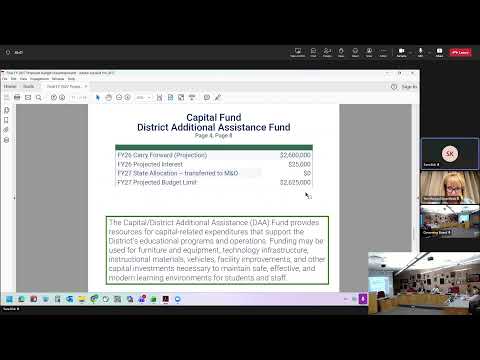
The presenter clarified the difference between current-year DAA allocation and prior-year carryforward: the current-year DAA is being moved to M&O to support personnel and other M&O costs, while about $2.6 million in prior carryforward remains in DAA to be used for capital obligations (the presenter described ‘‘hard’’ capital such as furnishings and facility improvements and ‘‘soft’’ capital such as software subscriptions and instructional aids). Staff said the district could, after FY26 close and once 40th-day ADM is known, consider moving a portion back to DAA (the presenter referenced a goal of restoring 25% if feasible).
On fund specifics, the presenter said the Classroom Site Fund (the 6/10 of a percent sales tax) is projected to have a budget limit of about $4.4 million in FY2027 (including carried forward balance and interest) and emphasized that CSF money is restricted for a short list of purposes such as teacher base salaries. The presenter also reviewed federal and state grant funds and cash-controlled local funds reported on the budget workbook’s page six.
No formal motions or votes were recorded during the hearing portion. The presenter repeatedly cautioned the board that the draft is based on incomplete statewide figures and would be revised as final state forms and updated ADM arrive.
The public hearing closed after questions; the presenter and attendees exchanged thanks and the board moved on to subsequent business.