Get Full Government Meeting Transcripts, Videos, & Alerts Forever!
Get email alerts on the Flood Mitigation topic
No spam. Unsubscribe anytime.
Richmond commission approves Step One engineering study for pump station and force‑main flood mitigation
Summary
The Town of Richmond Water and Sewer Commission voted Jan. 21 to hire Holt Tanner for a Step One engineering study to evaluate relocating a force main and pump station under the bridge; design is expected to be fully subsidized by CWS SRF, while full construction could run into the millions.
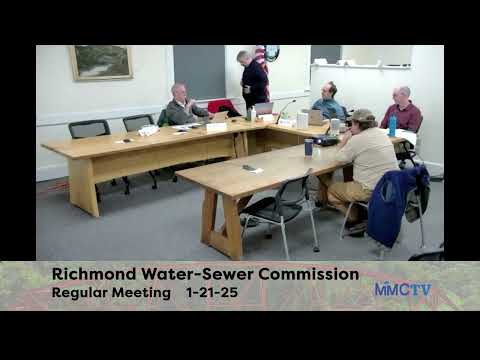
The Town of Richmond Water and Sewer Commission on Jan. 21 approved a Step One engineering services agreement with Holt Tanner to study flood mitigation options for the force main and pump station that cross under the bridge.
Commissioner Bart moved “to approve the step one engineering service agreement for flood mitigation for the forest Main and pump station and to appoint Town manager Josh arneson as the duly authorized representative,” and the motion was seconded and carried, according to the meeting record.
The agreement covers preliminary design work: Holt Tanner will evaluate either relocating the pump station or rerouting the force main beneath the bridge and produce Step One deliverables. Staff said the Step One design phase should be covered 100% by the Clean Water State Revolving Fund (CWS SRF). Commissioners noted that later construction and relocation phases are unlikely to be fully subsidized and could require additional funding.
During discussion commissioners and staff raised broad cost ranges for the full relocation or major reconstruction, citing figures discussed in the meeting up to roughly $2–2.5 million for a large relocation project. Staff and commissioners also discussed FEMA mitigation funding as a possible source to cover portions of control‑panel elevation work (one smaller mitigation item discussed was an estimated $5,800 pedestal/control elevation), and other state mitigation pots that fund preparedness projects not limited to disaster dollar‑for‑dollar reimbursement.
Commissioners framed the work as a two‑track approach: pursue the subsidized preliminary design now to develop options and cost estimates while planning smaller, shorter‑term mitigation actions that reduce near‑term flood risk. Several members cautioned that voter appetite for multi‑million‑dollar projects may be limited and that the town should be prepared to explain tradeoffs between temporary and permanent fixes before seeking large appropriations.
The agreement passed on a voice vote as recorded in the meeting transcript. Town manager Josh Arneson was authorized to sign the Step One agreement and act as the town’s representative for the contract.
What’s next: Holt Tanner will complete the Step One design work; staff said the firm’s final recommendations and cost estimates will inform future decisions about funding and whether to pursue larger construction phases.