Get Full Government Meeting Transcripts, Videos, & Alerts Forever!
Get email alerts on the City Budget Bond topic
No spam. Unsubscribe anytime.
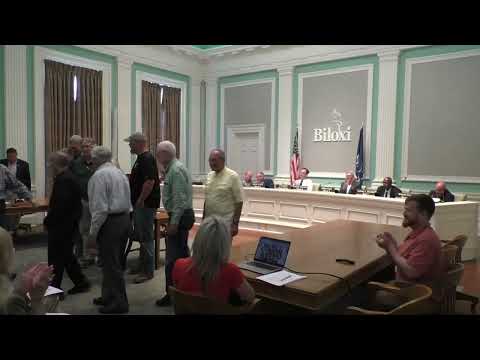
Biloxi council narrows 2026 bond authorization to $16.5 million after hours of debate
Summary
After more than three hours of debate and several failed amendment attempts, the Biloxi City Council approved an amended cap on a proposed general-obligation bond for capital projects; councilmembers split over scope and timing before passing a compromise amendment 4–3.
Biloxi’s City Council on June 16 debated and then approved an amended authorization for a general obligation bond intended to pay for streets, drainage, public-building repairs and other capital projects.
Councilmembers spent the bulk of the meeting arguing over how large the bond should be, with motions offered at $10 million, $15 million, $17.99 million and the original $18 million proposal. After multiple failed amendments the council adopted an amendment recorded as “165” that passed 4–3; the council referenced that figure during the vote as the compromise funding ceiling to move the program forward.
Finance staff had presented an engineer-driven project list with cost estimates that summed to about $14.46 million for a prioritized set of projects; staff and the mayor recommended adding roughly 10 percent contingency and using Mississippi Infrastructure Modernization Act (MIMA) funds where eligible to support debt service. Councilmember Paul Tisdale summarized the staff work and said the $14.46 million total was based on engineers’ estimates and other recent bids.
Opponents of a higher cap repeatedly argued the council had previously told residents it would seek roughly $10 million and cautioned about borrowing more than voters anticipated. Supporters, including Mayor Andrew Fo Gillis and Councilman Marshall, said delaying projects would increase construction costs and that the city can structure debt service using MIMA and other pledged revenues so the tax rate would not automatically rise because of the bonds.
In the course of the debate, councilmembers raised several recurring points: the need to fund repairs to city buildings (roofs, HVAC and generators), to replace aging water infrastructure in several neighborhoods, and to provide matching funds for grant-eligible MIMA projects that can leverage larger construction awards. Council members also discussed timing constraints tied to federal tax rules (spend 85% within three years) and practical limits on city staff and contractor capacity.
The record shows that the final amendment — recorded and approved in the meeting transcript as “165” and adopted by a 4–3 vote — became the working ceiling for the bond authorization. Councilmembers agreed that once the authorized amount is set the mayor and staff will bring project-level appropriation requests back to the council for approval, and that the list and priorities can be adjusted as grants and bids are secured.
What happens next: staff will finalize bond documents, align eligible projects with MIMA and other grant matches, and return to the council for specific appropriations and procurement steps. The council’s vote authorizes the borrowing ceiling; it does not by itself appropriate funds to individual projects.